
“To the German pilots honing in on our American bombers, it must have looked as though they were being attacked by a wave of flying underwear catalogs.”
Capt. Robert Morgan, as quoted by Donald Miller in Masters of the Air, pg. 117-8.
Friends,
When you think of the aircraft that won the war, one of the first things that come to mind is the pictures of cartoons, names, or more often, scantily clad women painted on them. The Air War over Europe was fought by young men. This is something the movies always seem to get wrong. Actors playing the roles are often in their late 20s or 30s. The men who flew the B-17s, B-24s, P-47s, P-51s, etc, were more often in their early twenties or late teens. As such, they tended to be interested in girls of the same age. Given the fact that we were engaged in a brutal worldwide war and for the men of the Army Air Corps (no Air Force during WW2) in Europe, life was the moment. There was no guaranteed future for them and for many, there was no future. Given the losses they suffered, who can blame them for living in the moment and grabbing whatever pleasure they could from their short time on earth.

Theirs was a different war than that faced by the ground forces. They fought and died in a cold, inhospitable climate where to remove a glove meant frostbite and to lose your oxygen connection meant death. Men, little more than kids, really, died in bouncing aircraft as they own blood froze on their clothing. They died, trapped by centrifugal force in bombers spinning towards earth. They died in crashes, crushed to death or burned, when landing gear failed. They died on the ground, sometimes killed by enraged civilians they had just bombed. They died when their chutes failed to open. They died when flak or 20mm cannon rounds shredded their planes and their bodies. Their life expectancy in combat hardly inspired confidence. In 1943, squadrons were losing over 100 percent of their available crews in the space of a few months.
Some named their aircraft after their mothers or a cartoon character or movie quote. But that seems to be the exception rather than the rule. Others named their plane after a wife or girlfriend (as in the case of the Memphis Belle). More still came up with a name that may be lewd or a double entendre. Here are just a few names from the 100th Bomb Group: Pasadena Nena, Angel’s Tit, Jersey Lilly, Sweater Girl, Mismalovin’, Miss Chief, Miss Behavin’, and Liberty Belle. My wife’s grandfather was the waist gunner on a B-17 named Luscious Lucy. It seems that they were split between blondes and redheads as the hair color of choice on their planes. Given the paint schemes on the aircraft, black or brunette would not have show up as well I think.

Luscious Lucy over England on a training flight over England, Feb. 1944 351st Squadron, 100th Bomb Group
Growing up, I had a strange fascination with World War Two aircraft. I could give you all sorts of details, armaments, turning radius, rate of climb, etc that was unusual for a child my age. What makes it even stranger is that I have a deep fear of flying. It was a strange juxtaposition that I cannot explain. I was lucky enough to know some of the men who flew these planes. My grandparents had a friend that we went to church with (his wife taught my Sunday School class) who was a co-pilot on a B-17. He was shot down and spent a year in a German POW camp. I’ve met a few others along the way too. Brave men, all. I wish I had known my wife’s grandfather as I am sure that he had stories to tell, though, like many of his generation, he was tight lipped about it. He flew seven missions as a waist gunner, including the first daylight raid over Berlin. On one mission, one of his fellow crewmembers was struck in the chest and eviscerated by a 20mm cannon round fired by a German fighter. His blood froze on the clothing of his crew.Her grandfather flew and fought at his position for several hours with frozen entrails clinging to his flight clothes.
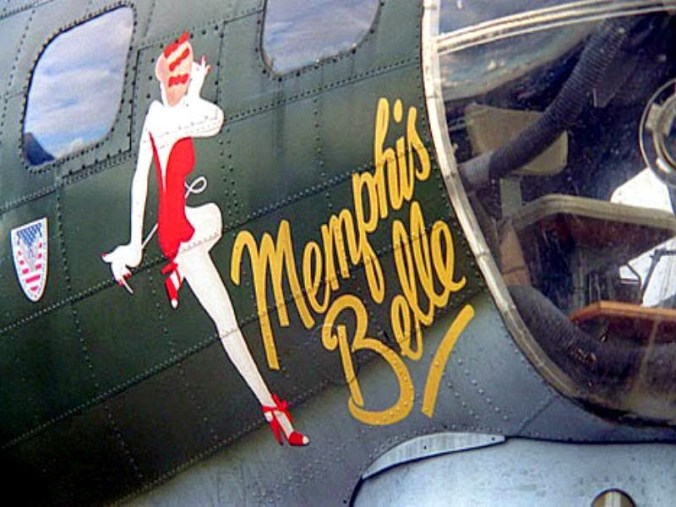
Now I know that by our standards today, such images as those that decorated the planes of World War Two are seen as sexist, degrading, and/or objectifying of women. But I humbly state that they lived in a different era. They were young, and many died terrible deaths. If such images brought them comfort, well, who can really blame them? We should not judge unless we too flew those brutal missions over Germany. Only those who have been there can fully understand. I will now leave you with a quote from a poem by Randall Jarrell entitled Losses. It is, in my opinion, some of the best words written in the English language about warfare:
In our bombers named for girls we burned
The cities we had read about in school
Hutch
My sexy pinup girl.

 Ghosts of the Past