Reaping the Whirlwind (Pt. 4)

image1

Dear Readers,

I’ve reached the 1/3rd point of my work in progress. It’s been a mixture of slow and fast going. I write much slower now than I ever have before. When in college, I could dash off 10 pages in a matter of an hour or two. Now, my 3,000 word a day limit sometimes takes me the better part of 6 hours to finish. Of those words, maybe half of them are actually any good. But books a rewritten more than they are written. That’s what editing is for. The important thing is to get the first draft finished. I’ve identified several issues with the overall plot and layout which will require extensive revision. I may end up cutting the four characters down to two so that I can get more in depth into them and their world. We’ll see. There is much left to write.

As I slave away in front of the computer, I have been pondering great works of World War 2 fiction that I’ve read in my life. If you are a writer, you have your favorites that influence your style and even the type of fiction you write. I’m a HUGE fan of the Dave Robicheaux series by the great James Lee Burke. Indeed, my completed novel is a mystery set in a fictitious Texas town on the Gulf Coast. It’s pretty good, actually. I haven’t take the time to revise and edit it though. I might once I finish with my current project. So please allow me a few moments to discuss my favorite World War 2 novels. For those who tough it out to the end, you’ll get to read the opening of my own novel So Others May Live. 

Bomber by Len Deighton. This is an incredibly written novel which takes place over a 24 hour time span. It details everything that went into planning and carrying out a bombing raid on the fictitious German town of Altgarten. At the same time, it also details the town itself with all its secrets and intrigue. Deighton is a master storyteller. As an added bonus, the BBC did a radio dramatization of the novel in the early 90s too, so you can both read it and then listen to a radio version of it. Both are excellent. I would tell people that if they read any novel about the Second World War, make it this one.

A Time to Love and a Time to Die by Erich Maria Remarque. Wait, I hear you saying, isn’t he the guy that wrote All Quiet on the Western Front? Yes, Dear Readers, he is. This novel is, in my opinion, perhaps better even than his best known work. It takes place over a short span of time and involves a German soldier on leave from the Eastern Front. Particularly evocative of the paranoia and claustrophobia of wartime Germany, Remarque does an excellent job showing the behavior of people in wartime. It is worth noting that Remarque’s books were banned in Nazi Germany and he fled to Switzerland. In retaliation, the Nazis arrested his sister who remained behind. At her trial for undermining morale, the judge said “Your brother is unfortunately beyond our reach but you, however, will not escape us.” She was beheaded in 1943. Remarque eventually immigrated to the United States and became and American citizen. He married actress Paulette Goddard who was both incredibly hot and a redhead. But I digress.

The Burning Blue by James Holland. A friendship. A forbidden love affair with a best friend’s twin sister. Spitfires. The Battle of Britain. They blend together in this wonderful novel to create a perfect tale of wartime England. Told through a series of flashbacks whilst the main character lies recovering in a hospital bed in North Africa, the book starts a few years before the war and builds towards an exciting climax. You feel for the main character as he lives on a razor’s edge during the Battle of Britain. You want him to get the girl and you genuinely grieve when he doesn’t. Or does he? The aerial combat scenes are magnificent as are the personal interactions between the characters. Holland is a master of aviation fiction. (See his other work A Pair of Silver Wings as well.) For fans of British period dramas (Foyle’s War, etc) or The Battle of Britain, I highly recommend this novel. If you want to find yourself behind the controls of a Spit, read this book at once.

Berlin by Pierre Frei. This is technically not a World War 2 novel as it is set in Berlin, but it is at least in the immediate post-war period. A serial killer stalks the streets and a Kripo detective is partnered up with the Americans to track him down. What is really neat about this novel is that you have a chapter about each victim that tracks their lives up until the instant they are murdered. Then you’ll have a chapter about the investigation of their death. Getting deep into the lives of the characters makes their deaths all the more tragic. The novel does an incredible job of describing post-war Berlin; the hunger, the black market, the fraternizing between GIs and German girls that wasn’t supposed to be taking place, the secrets people tried to keep about the lives during the Nazi era. The author was born in Berlin in 1930 and grew up there. First published in German in 2003, it was translated to English in 2005. Definitely read this, especially if you like murder mysteries.

Payback by Gert Ledig. “When the first bomb fell, the blast hurled the dead children against the wall.” Holy F–k! What an opening! This book is rare and difficult to get a copy of, though used copies do exist. First published in German in 1956, it was not translated into English until 1999. The author served on the Eastern Front and was sent home after he was wounded near Leningrad. Whilst at home, he experienced Allied air raids which are the subject of this novel. The book isn’t long. The whole thing takes place over the course of an hour or so in a nameless town as it is pummeled by bombs. Each short chapter tells about one person in the town. Before each chapter is short piece where the character introduces themselves to the reader. You see the raid unfold with all its macabre horror. From a 16 year old girl raped in a cellar as bombs fall to the dead unburied by explosions and hurled into the trees, Payback provides a stomach churning glance into life under the bombs. The book is controversial because British and American audiences do not generally like to read about what their bombs did. Still, this book is an anti-war classic and a must read.

Now, Dear Readers, as promised, here is the opening to So Others May Live. Keep in mind this is an unedited first draft and I cannot state with certainty that this will be the opening scene in the finished product and even if it is, it’ll probably be a bit different.

Fire. A tornado of fire. Flames shot upwards, a thousand feet or more, and turned the night sky to daylight. Wind swirled around the base of the inferno. Over the roar of the conflagration, a new sound emerged like the scream of wounded animals. People staggered over the rubble choked streets as the heat seared their bodies. Clothing burst into flame. The human torches ran in circles until they dropped to the street and lay still. The wind grew in intensity until it lifted, first children and then adults, and hurled them into the seat of the fire. They screamed and flailed in the air until the flames devoured them. Hair burned. Clothes burned. Even the streets burned. The odor roasted flesh overpowered that of the phosphorus driven firestorm. Somewhere, a bell rang.  

There you have it, friends.

Hutch

The Flying Lingerie Adds That Helped Win the War: How Lewd!

images

“To the German pilots honing in on our American bombers, it must have looked as though they were being attacked by a wave of flying underwear catalogs.”

            Capt. Robert Morgan, as quoted by Donald Miller in Masters of the Air, pg. 117-8.

Friends,

When you think of the aircraft that won the war, one of the first things that come to mind is the pictures of cartoons, names, or more often, scantily clad women painted on them. The Air War over Europe was fought by young men. This is something the movies always seem to get wrong. Actors playing the roles are often in their late 20s or 30s. The men who flew the B-17s, B-24s, P-47s, P-51s, etc, were more often in their early twenties or late teens. As such, they tended to be interested in girls of the same age. Given the fact that we were engaged in a brutal worldwide war and for the men of the Army Air Corps (no Air Force during WW2) in Europe, life was the moment. There was no guaranteed future for them and for many, there was no future. Given the losses they suffered, who can blame them for living in the moment and grabbing whatever pleasure they could from their short time on earth.

strawberry_bitch_nose_art640

Theirs was a different war than that faced by the ground forces. They fought and died in a cold, inhospitable climate where to remove a glove meant frostbite and to lose your oxygen connection meant death. Men, little more than kids, really, died in bouncing aircraft as they own blood froze on their clothing. They died, trapped by centrifugal force in bombers spinning towards earth. They died in crashes, crushed to death or burned, when landing gear failed. They died on the ground, sometimes killed by enraged civilians they had just bombed. They died when their chutes failed to open. They died when flak or 20mm cannon rounds shredded their planes and their bodies. Their life expectancy in combat hardly inspired confidence. In 1943, squadrons were losing over 100 percent of their available crews in the space of a few months.

100_1303

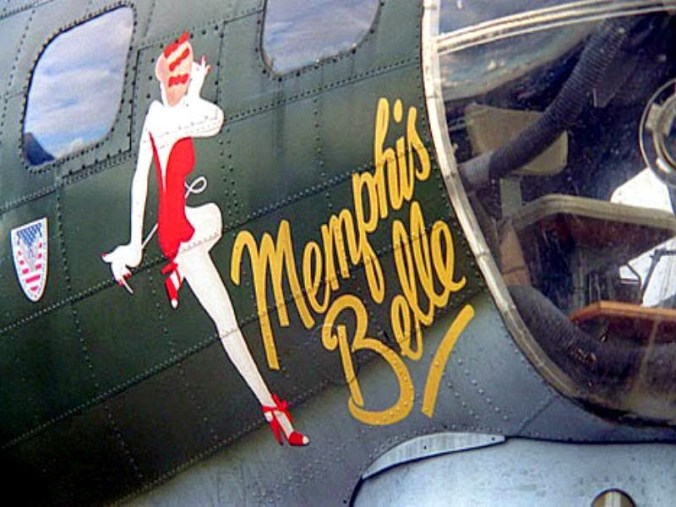
Some named their aircraft after their mothers or a cartoon character or movie quote. But that seems to be the exception rather than the rule. Others named their plane after a wife or girlfriend (as in the case of the Memphis Belle). More still came up with a name that may be lewd or a double entendre. Here are just a few names from the 100th Bomb Group: Pasadena Nena, Angel’s Tit, Jersey Lilly, Sweater Girl, Mismalovin’, Miss Chief, Miss Behavin’, and Liberty Belle. My wife’s grandfather was the waist gunner on a B-17 named Luscious Lucy. It seems that they were split between blondes and redheads as the hair color of choice on their planes. Given the paint schemes on the aircraft, black or brunette would not have show up as well I think.

lusciouslucy

Luscious Lucy over England on a training flight over England, Feb. 1944 351st Squadron, 100th Bomb Group

Growing up, I had a strange fascination with World War Two aircraft. I could give you all sorts of details, armaments, turning radius, rate of climb, etc that was unusual for a child my age. What makes it even stranger is that I have a deep fear of flying. It was a strange juxtaposition that I cannot explain. I was lucky enough to know some of the men who flew these planes. My grandparents had a friend that we went to church with (his wife taught my Sunday School class) who was a co-pilot on a B-17. He was shot down and spent a year in a German POW camp. I’ve met a few others along the way too. Brave men, all. I wish I had known my wife’s grandfather as I am sure that he had stories to tell, though, like many of his generation, he was tight lipped about it. He flew seven missions as a waist gunner, including the first daylight raid over Berlin. On one mission, one of his fellow crewmembers was struck in the chest and eviscerated by a 20mm cannon round fired by a German fighter. His blood froze on the clothing of his crew.Her grandfather flew and fought at his position for several hours with frozen entrails clinging to his flight clothes.

memphisbellenoseart

Now I know that by our standards today, such images as those that decorated the planes of World War Two are seen as sexist, degrading, and/or objectifying of women. But I humbly state that they lived in a different era. They were young, and many died terrible deaths. If such images brought them comfort, well, who can really blame them? We should not judge unless we too flew those brutal missions over Germany. Only those who have been there can fully understand. I will now leave you with a quote from a poem by Randall Jarrell entitled Losses. It is, in my opinion, some of the best words written in the English language about warfare:

In our bombers named for girls we burned

The cities we had read about in school  

Hutch

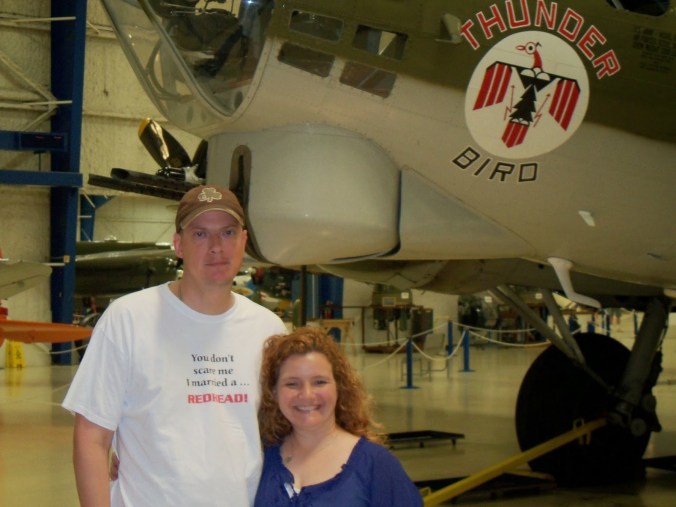
100_1280

My sexy pinup girl.


The “Good” Old Days Weren’t

good-old-days

Dear Readers,

There is a false impression of the past shared by many who long for the “good old days”. In the eyes of some, in the past people did nothing but go to church, pray, and do good deeds every day. It’s bulls!t, of course, but the mythic view of the American past survives and is still alive and well today. The truth is, however, that from child prostitution to murder most foul, the 19th Century had it all. The same issues we face now were, for the most part, around back then too. There truly is nothing new under the sun.

In the 1860s, an Englishman visited New York City after the end of the Civil War. He left a wonderful account called Sunshine and Shadow in New York. Though naturally you have to take some of his words with a dose of salt, much of it rings true. Smith, the author, reported that the NYPD in 1866 listed 615 Houses of Prostitution, 99 Houses of Assignation, 75 Concert Saloons of vile repute, 2,690 Prostitutes, 629 waiter girls, and 127 vile bar maids. He goes on to say that waiter girls “are not of the highest moral order”. Now I’m not entirely sure what the difference between a house of prostitution and a house of assignation is, but I assume there must have been one as they were listed separately. Smith also observed “cheap hotels are used for the purposes of infamy.” In other words, they had no tell motels back then too! 30 years earlier, another visitor when speaking of the Five Points said “Every house was a brothel, and every brothel a hell.”

Inside these establishments, women engaged in the oldest profession. Some by choice, but more often by necessity. Girls coming from the countryside to look for work in the city often found themselves drugged and shanghied into a life of prostitution. I also use the word “women” but in reality, many of them were either barely into adulthood or not adults at all. Rumors persisted in the 1860s that Bridget McCarthy who owned a brothel on the corner of Mott and Bayard specialized in providing young virgins for men from the upper classes. When I say young, I mean in the 11-13 age range. Technically it was sort of frowned on, but perfectly legal.

And it wasn’t just New York City. Descriptions of other large cities from the era, including London, are similar to what Smith described in his book. Did you have such goings on in rural areas too? Not to this extent, of course, but yes, violence, child sex abuse, and murder existed in small towns as well. And speaking of murder, everyone has at least heard of Jack the Ripper. But did you know that three years before his reign of terror in London’s East End, another killer stalked the streets of Austin, Texas? Austin was not a big city at all in 1884-5, though it was the state capital. This killer became known as The Servant Girl Annihilator which, in my opinion, is the greatest serial killer name of all time.

Most of your big city newspapers from the period are available on microfilm. If there is a university near you, they probably have enough of them that you can get a good look at life from 1865-1900. Just as now, they talk about crime, corruption, scandal, etc. Spend time reading them and you’ll find that life back then was not all that different than today. In other words, there is no such thing as “the good old days”. Especially if you were a minority.