Reap the Whirlwind (Pt. 8)

image1

Friends,

The novel is now around 66% complete. Assuming I am able to keep to my chapter a day writing schedule, it will be finished on Friday, June 30th. This is a good thing because I’m teaching a US History Since 1877 course the second half of the summer, so it is imperative that I have this knocked out before the class starts. For the subject of today’s post, I will discuss the challenges of writing historical characters, but particularly historical characters who hail from countries other than your own.

An Englishwoman. An Irishman. And two Germans. Sounds like a joke, right? But it is actually where my characters come from. Let us consider for a moment the English language. It has a wide variety of accents and dialects. Consider this point as well. Before television, regional accents tended to be a bit more pronounced than they are now. I have no problem understanding Irish accents but I can’t understand a Bostonian to save my life. Writing this into a novel is tough. You want to give the flavor of where the characters are from, but at the same time you don’t want to descend into a such heavy dialect in the speech that the reader can’t understand what they are saying. A bit of this is okay, I suppose, but you don’t want to go overboard. Dialogue is difficult enough to write as it is. But what if your characters aren’t from the same country as you AND they speak a different language?

If you were to read my novel, obviously you will know without me having to tell you that the German characters are really speaking German but I am writing in English. One thing I’ve noticed on this point is that when British authors write German characters, their English sounds British and when Americans do it, their English sounds American. Either is okay, I guess. But remember that when you are talking about historical characters, their speech has to be at least a little reminiscent of the era in which they lived. Don’t put characters using modern slang in a historical novel! Period! Just don’t! If you are in doubt, leave it out!

And what of historical attitudes? This, Dear Reader, is a tough one. Some writers create characters that have such modern attitudes and feelings on issues that they would have never existed historically. Since two of my characters reside in Nazi Germany in 1943, you can see the dilemma. I’ve read tons of World War 2 fiction. I’ve noticed that German characters typically fall into two categories. You have the ardent anti-Nazis and then you have the stereotypical arrogant and evil Nazi villain. Of course both groups existed in Nazi Germany, but what of the others? The people who, while passively complicit in Nazism, simply lived their lives as best they could under the circumstances. One thing I always tell my history students is to never tell me what they would have done if they had lived back then. Everyone is a badass until it is time to be a badass. We have the Milgram Experiment and the Stanford Prison Experiment and a the whole weight of history to show us that most people go along in order to survive.

So, where does that leave us? Ursula, my redheaded heroine (patterned on my German wife, I might add) is a member of a resistance cell in Berlin tasked with a dangerous assignment, made more dangerous by an air raid. The Gestapo is trailing her trying to find out more information on who she is working for. She represents Germans who fought back against the Nazis. Karl, the firefighter, is a bit more complicated and I think does a better job representing the average person in Germany at the time. His father was killed in the First World War. Karl joined the Fire Brigade in Berlin at the age of 19 (in 1929). He joined the Party after it was made clear that his failure to do so would bring about his dismissal. As a reservist, he was called to active duty in August of 1939 and spent the next few years fighting in Poland, France, and Russia where he was seriously wounded. After a protracted recovery, he was discharged and resumed his duties with the Fire Brigade.

In Russia, he took part in anti-partisan operations among other things and speaks of executing Russian civilians with a certain measure of regret. He disagrees with the excesses of Nazism but at the same time he states they are the only think standing between Western Europe and the Communists. He is ambivalent about Hitler and the Party hierarchy. Like many residents of Berlin at the time, Karl has quite a bit of cheek and pokes fun (in private) at several Nazi officials. As Karl spent time in the East, he knows better than most what the Nazis are up to. He doesn’t like it, but he considers it a matter entirely outside of his control. There is much to admire in his character; his kindness to children and animals, his devotion to the men he works with, and his dedication to the citizens of Berlin. But at the same time, he has his dark side too. Such a character is, in my opinion, a somewhat accurate depiction of the German Everyman during World War 2. They weren’t all resisters. They weren’t all ardent Nazis. Most fell in the middle.

The problem from the standpoint of a writer is will people be able to care about what happens to such a character? He is neither good nor evil. Just a man trying to survive, though for what he does not know. The book makes no judgement on “good guys” and “bad guys”. In fact, the antagonist that everyone, both in England and Germany, are fighting against is the war itself. Some characters may be more sympathetic than others, but I’ll leave that up to the readers one day. All I can say is that this is a tough book to write, given the subject matter and the amount of research involved. It’s tough, but I’m doing it. Little by little. I’m getting it done.

Hutch


Reaping the Whirlwind (Pt. 6)

der-alliierte-bombenterror-gegen-deutschland-im-zweiten-weltkrieg-wie-hier-in-braunschweig-war-ein-unverzeihliches-verbrechen-gegen-die-menschheit

Date: Monday, November 22, 1943

Time: 2230

Picture yourself in the dark interior of a brick lined basement. The stench of unwashed bodies and fear overcomes the odor of mildew. A thin sheet used as a curtain in a corner hides a large bucket, the only toilet available for the two dozen people packed into the small room. Everyone sits on wooden benches. Their ages range from elderly to infants. There are no able bodies men present, as they are all at the front. A few buckets of sand line the floor and everyone wears a helmet, even the children. A radio in the corner keeps up a running commentary on what is taking place above ground. Enemy bomber formations have passed east of Braunschweig. Anticipated target is Berlin. Outside, the sirens howl. Then, antiaircraft batteries open fire, sending sheets of flame shooting into the night sky. And then you hear it, the shriek of falling bombs. Each one explodes with a loud CRUMP which causes your building to shake. Dust drifts down from the ceiling. The bombs march closer and closer. Some of the children start to cry. A few of the adults begin to pray. Will the next bomb have your name on it? Or will it hit the next block?

p_aircrew1

Now picture yourself in the sky overhead. Searchlights stab at the sky around you. To be caught in one means death, unless you can escape the cone. This is your 30th mission. If you make it back, you’ll be the first in your squadron to complete a tour in several months. Before takeoff, you learn that some of the other crews have placed bets on your odds of survival. The odds aren’t good. In the past five months, you’ve seen crews come and go. New crews get shot down so fast you don’t have time to learn their names. Two of your own crew died a few nights ago over the same city where you find yourself now. A burning Lancaster drifts across your line of sight. It rolls onto its side and plummets towards the ground, the seven men inside trapped in a fiery coffin. Your bomb aimer, in the nose of your plane, calls out corrections as you reach the target indicators. Left, left. Steady. Right. Right. Steady. Steady. Almost there. A sudden noise makes you jump as your rear gunner opens up on a night fighter. Shrapnel from the flak batteries ping against the side of your plane, like a child throwing pebbles against it. And then the searchlights catch you.

ff6a5152ee2f09dc2300146e2f13b17a

Now transport yourself 600 miles away. Several months ago, you met a young pilot while he was on leave. Six weeks ago, he proposed and you said yes. When he completes his tour tonight, he’ll be off operations for a while and receive a much safer assignment as an instructor pilot. You know he is flying tonight, and you’ll be married in three days time. As the searchlights catch his aircraft, you are traveling to the small village near his airbase so you can greet him when he gets back. There’s something you need to tell him before the wedding. You meant to do it when you saw him a couple of days ago, but you couldn’t bring yourself to do it. Will he care? Will he cancel the wedding? He seemed withdrawn last time you saw him. And with good reason, he’d just come back from a mission in which two of his crew were killed and one seriously injured. That’s why he got a weekend pass to begin with. His last words when you parted at the train station were “I’m glad I met you.” Hardly the words of a man planning on having a future.

image1

Let us now return to the city under the bombs. You wait out the raid in a reinforced room on the ground floor of your fire station. In the midst of war, your job is still to save lives. You are a veteran fireman with over ten years on the job. The war interrupted your career and you spent several years on the front lines in Poland, France, and Russia before an injury led to your discharge, aided by the fact that cities needed experienced fire service personnel. You saw the firestorm in Hamburg and its images flash through you mind every time you close your eyes. And now? Now your city is being pounded. As soon as the heaviest bombing passes, you and your crew, one other experienced man and four young women who belong to the Luftschutz leave the station and drive towards the fires burning in the distance. A few bombs are still falling, and as you pull up in front of a blazing apartment building, a bomb explodes just up the block. Shrapnel leaves pockmarks on your truck, but it cuts down four firemen in the street ahead. You can hear the screams over the roar of the flame as you exit the fire engine and go to work. A quick glance up. You see a bomber caught in the searchlights. Black objects tumble from the center of the plane and start their way towards the ground. Towards you.

This gives you a bit of insight into the four main characters in the novel. They all have their own backstories and personal conflicts not necessarily detailed above. I hope that when I am finished, they will become as real to you as they are to me.

Hutch


Reap the Whirlwind (Pt. 5)

80cf81109cbb77d271a157c3b650934c

Friends,

This post continues a series on my novel in progress. If you are new to the blog, you can catch up on the previous posts here: OneTwoThree, and Four. The novel is now almost halfway complete, though to be honest I have dealt with writer’s block and accompanying challenges over the past couple of months which brought things to a full stop. The second half of any semester is the most difficult for me, teaching wise, since I am snowed under with grading and then end of the semester paperwork. The pain from my injuries is a daily thing which ranges from moderate to murderous. The past six weeks or so, it has been murderous. When you can’t sit for more than 15 or 20 minutes, stand for more than an hour or two, or lie down for more than an hour, it is difficult to focus on anything else. Athletes play with pain. Writers write with pain. I guess I’ll have to just suck it up and soldier on. Something else has been gnawing at me too. Something which I don’t quite know how to handle.

I am a perfectionist in some things. Teaching is one of them. Writing is another. I agonize over every word I say in the classroom. I feel such a solemn obligation to the past that I worry that I’m not doing justice to the experiences of those who lived through the events I teach about. At the end of every class, I engage in self destructive criticism of the day’s lecture where I think of all the better ways I could have said something. Needless to say, I do the same with my writing. Given the current work is an historical one, and of a subject that does not get much attention in the way of fiction, I feel the same sacred obligation. I will type, delete, type, delete, and then type and delete the same line five or six times until I think it sounds right, only to do it all over again when I read over the completed chapter. Once upon a time, I could dash out 6 or 7K words a day in a matter or three or four hours. Now it takes closer to 7 or 8 hours to write 3K words, which is my daily goal. On one hand, being a perfectionist is a good thing when it comes to writing, but on the other and much larger hand, it definitely slows me down.

become-a-writer

Like all writers, I struggle with self doubt. Writing is such a solitary endeavor that forces you to spend hours inside your own head where your personal demons sally forth to assail your confidence. Is anyone going to pay money to read this? It isn’t good enough! The side of a cereal box is more interesting than this garbage! You aren’t going to finish it anyway! I put tremendous pressure on myself. Without getting into too much detail, I teach history part time at a community college. For over ten years, I’ve slaved away at the lowest rung of the academic ladder. Despite two Master’s Degrees, a career outside academia, and a decade of direct experience, it has become blatantly obvious that I will never get a full time faculty position. Given the extent of my injuries, I can’t really do much else and to be fair, I’m not sure I could even handle one of those positions anyway. I’ve been a finalist many times, but these days I can’t even get a first interview. As much as I love being in the classroom, the writing is on the wall. If education, experience, excellent evaluations, and stellar student reviews are not enough to land you a position, then I need to get over my stubborn streak and accept defeat. What does that have to do with my writing? Well, to be blunt, the time has come for my writing to pay. In order for it to pay, I have to beat the writer’s block. And what I write has to be, you know, good. Writing is a struggle. I doubt it comes easy for even the best among us, I do not number among that group.

When you write a period piece, you really have to get inside the period as best you can. My novel is set in 1943 and takes place in two primary locations. Berlin and the inside of a Lancaster bomber. I’ve been out of the right mindset for a long time, so this week I’ve been doing nothing but listening to music from 1939-43 (both British and German) and watching movies and newsreels from the same years. It takes a few days for me to get my mind right to write (see what I did there). I’ve been going through my research files as well as reading the first 11 chapters over again. There is stuff I need to change, but I’m not allowing myself to do that until I’m done with the entire thing. Poring over photos of bomb ruins and bombing victims, reading interview notes, and examining documents and reports is a difficult task, but one you have to do if you want to get it right. Or as right as you possibly can without having been there yourself.

So excuse me now as I gallop off into the sunset on my trusty steed with a redheaded saloon girl behind me in the saddle. (Hmmm…….maybe I should write a western next.)

Alas, I have no horse but I am married to redhead.

Hutch

Pass the Pint, London Can Take It

Friends, Romans, Countrymen,

Yesterday I was interviewed by my esteemed colleague Dr. AJP. You can read my interview here if you’d like. It consists of how I came to teach history and what projects I’m working on. One of the questions asked specifically about my blog and I had to admit it has been some time since I’d put words on the internets. Far too long. My problem is that I have the attention span of a 6 month old baby. I’ll write religiously for a month or two and then I’m like “Oh…..look…..shiny things!” and next thing you know a few months have gone by without a post. I don’t have a good excuse, so I won’t waste your time giving you a bad one. In the interview, I do mention my novel project which as you may recall was the subject of a four part series I wrote. You can find the first article here and sort of take it from there.

Properly chastened, I sallied forth this morning to try and find a worthy subject of which to write. Truth be told, the subjects are worthy of a better writer than I, but I digress. Normally I make a pointed effort to not discuss current events on my blog. It isn’t that I don’t have opinions on things, of course I do, but I don’t really think you’d be interested them. However, today I will break my rule a tiny little bit, only because it is what inspired what I decided to write about.

You’d have to be living under a rock to not know about the terrible tragedies to strike Manchester and London. Nothing I can say would bring comfort to those mourning the loss of a loved one. However, a certain picture making the rounds on social media caught my eye and sparked today’s topic. I chuckled when I saw the photo of the gentleman racing away from the scene of the London attack with his pint. Given drink prices in London, I don’t blame him. But it also speaks to something else. Something deeper.

16029995-large

On this, the eve of the D-Day anniversary, we in the United States should remember that before we entered the war, and even before Hitler invaded the Soviet Union, the British stood alone against Hitler. The Germans hit London hard. At one point, German bombers flew over the city on 57 consecutive nights. People lost their homes and their lives. Over 1 million British homes were damaged or destroyed and half of all British deaths took place in London. Add to that 1,000 British firefighters who died in the line of duty.  In October of 1940, the British government commissioned a short film called London Can Take It. It was primarily aimed at an American audience to reassure them there was no chance of the British giving up. To quote Churchill, the “full fury and might of the enemy” was indeed turned upon them and the British public emerged from the darkness and carried on into a future which saw IRA bombing campaigns and now attacks by Jihadis.

It also reminded me of an audio file I listened to of a Lancaster crew over Germany in 1943. The same spirit of the man carrying the pint can be heard in their voices. “They’re firing at us now.” “Are they?” “Yep.” The boys in Bomber Command were in their late teens and early twenties. They came from all over the Commonwealth. Australians crewed planes alongside South Africans, Welshmen, Canadians, and Scots. Night after night they flew over blacked out German cities bristling with vipers nests of searchlights and Flak batteries. Night fighters prowled the skies looking for them. Nearly half of all Bomber Command crews were killed in action. The odds of finishing a tour of 30 ops in 1943 or 44 were long indeed, yet they kept calm and carried on (a phrase coined by Churchill during the Blitz). These men had gigantic balls made of steel.

p_aircrew1

The same spirit which saw the British through the dark days of the Second World War and the dark days of IRA attacks in British cities from the 70s-90s will no doubt see them through their current situation. You will never defeat a country where people think to save their pint in the midst of unspeakable horror. You will never defeat a country where people, night after night, listen to German bombs raining down upon them with no thought of surrender. You will never beat a country willing to stand up to the Nazis alone. The resolve of the British people is, quite simply, unbreakable.

Hutch


Reaping the Whirlwind (Pt. 4)

image1

Dear Readers,

I’ve reached the 1/3rd point of my work in progress. It’s been a mixture of slow and fast going. I write much slower now than I ever have before. When in college, I could dash off 10 pages in a matter of an hour or two. Now, my 3,000 word a day limit sometimes takes me the better part of 6 hours to finish. Of those words, maybe half of them are actually any good. But books a rewritten more than they are written. That’s what editing is for. The important thing is to get the first draft finished. I’ve identified several issues with the overall plot and layout which will require extensive revision. I may end up cutting the four characters down to two so that I can get more in depth into them and their world. We’ll see. There is much left to write.

As I slave away in front of the computer, I have been pondering great works of World War 2 fiction that I’ve read in my life. If you are a writer, you have your favorites that influence your style and even the type of fiction you write. I’m a HUGE fan of the Dave Robicheaux series by the great James Lee Burke. Indeed, my completed novel is a mystery set in a fictitious Texas town on the Gulf Coast. It’s pretty good, actually. I haven’t take the time to revise and edit it though. I might once I finish with my current project. So please allow me a few moments to discuss my favorite World War 2 novels. For those who tough it out to the end, you’ll get to read the opening of my own novel So Others May Live. 

Bomber by Len Deighton. This is an incredibly written novel which takes place over a 24 hour time span. It details everything that went into planning and carrying out a bombing raid on the fictitious German town of Altgarten. At the same time, it also details the town itself with all its secrets and intrigue. Deighton is a master storyteller. As an added bonus, the BBC did a radio dramatization of the novel in the early 90s too, so you can both read it and then listen to a radio version of it. Both are excellent. I would tell people that if they read any novel about the Second World War, make it this one.

A Time to Love and a Time to Die by Erich Maria Remarque. Wait, I hear you saying, isn’t he the guy that wrote All Quiet on the Western Front? Yes, Dear Readers, he is. This novel is, in my opinion, perhaps better even than his best known work. It takes place over a short span of time and involves a German soldier on leave from the Eastern Front. Particularly evocative of the paranoia and claustrophobia of wartime Germany, Remarque does an excellent job showing the behavior of people in wartime. It is worth noting that Remarque’s books were banned in Nazi Germany and he fled to Switzerland. In retaliation, the Nazis arrested his sister who remained behind. At her trial for undermining morale, the judge said “Your brother is unfortunately beyond our reach but you, however, will not escape us.” She was beheaded in 1943. Remarque eventually immigrated to the United States and became and American citizen. He married actress Paulette Goddard who was both incredibly hot and a redhead. But I digress.

The Burning Blue by James Holland. A friendship. A forbidden love affair with a best friend’s twin sister. Spitfires. The Battle of Britain. They blend together in this wonderful novel to create a perfect tale of wartime England. Told through a series of flashbacks whilst the main character lies recovering in a hospital bed in North Africa, the book starts a few years before the war and builds towards an exciting climax. You feel for the main character as he lives on a razor’s edge during the Battle of Britain. You want him to get the girl and you genuinely grieve when he doesn’t. Or does he? The aerial combat scenes are magnificent as are the personal interactions between the characters. Holland is a master of aviation fiction. (See his other work A Pair of Silver Wings as well.) For fans of British period dramas (Foyle’s War, etc) or The Battle of Britain, I highly recommend this novel. If you want to find yourself behind the controls of a Spit, read this book at once.

Berlin by Pierre Frei. This is technically not a World War 2 novel as it is set in Berlin, but it is at least in the immediate post-war period. A serial killer stalks the streets and a Kripo detective is partnered up with the Americans to track him down. What is really neat about this novel is that you have a chapter about each victim that tracks their lives up until the instant they are murdered. Then you’ll have a chapter about the investigation of their death. Getting deep into the lives of the characters makes their deaths all the more tragic. The novel does an incredible job of describing post-war Berlin; the hunger, the black market, the fraternizing between GIs and German girls that wasn’t supposed to be taking place, the secrets people tried to keep about the lives during the Nazi era. The author was born in Berlin in 1930 and grew up there. First published in German in 2003, it was translated to English in 2005. Definitely read this, especially if you like murder mysteries.

Payback by Gert Ledig. “When the first bomb fell, the blast hurled the dead children against the wall.” Holy F–k! What an opening! This book is rare and difficult to get a copy of, though used copies do exist. First published in German in 1956, it was not translated into English until 1999. The author served on the Eastern Front and was sent home after he was wounded near Leningrad. Whilst at home, he experienced Allied air raids which are the subject of this novel. The book isn’t long. The whole thing takes place over the course of an hour or so in a nameless town as it is pummeled by bombs. Each short chapter tells about one person in the town. Before each chapter is short piece where the character introduces themselves to the reader. You see the raid unfold with all its macabre horror. From a 16 year old girl raped in a cellar as bombs fall to the dead unburied by explosions and hurled into the trees, Payback provides a stomach churning glance into life under the bombs. The book is controversial because British and American audiences do not generally like to read about what their bombs did. Still, this book is an anti-war classic and a must read.

Now, Dear Readers, as promised, here is the opening to So Others May Live. Keep in mind this is an unedited first draft and I cannot state with certainty that this will be the opening scene in the finished product and even if it is, it’ll probably be a bit different.

Fire. A tornado of fire. Flames shot upwards, a thousand feet or more, and turned the night sky to daylight. Wind swirled around the base of the inferno. Over the roar of the conflagration, a new sound emerged like the scream of wounded animals. People staggered over the rubble choked streets as the heat seared their bodies. Clothing burst into flame. The human torches ran in circles until they dropped to the street and lay still. The wind grew in intensity until it lifted, first children and then adults, and hurled them into the seat of the fire. They screamed and flailed in the air until the flames devoured them. Hair burned. Clothes burned. Even the streets burned. The odor roasted flesh overpowered that of the phosphorus driven firestorm. Somewhere, a bell rang.  

There you have it, friends.

Hutch

Reap the Whirlwind (Pt 2)

80cf81109cbb77d271a157c3b650934c

Dear Readers,

Typically I’m not a big fan of doing too much talking about a writing project as I feel it saps the creativity that one needs to actually finish said project. I’ll make an exception here, mainly since I’ve alluded to it in another post which you can find here. In fact, you might want to read that one first as it will give you some historical background. So….here is the plot in a nutshell:

Two men. Two women. One night. Michael, a bomber pilot, proposed to Grace, but now fears leaving her a widow. Grace has a secret past that could change their relationship forever, but she can’t tell him. At least not yet. A thousand miles away in Berlin, Karl, a grizzled veteran of war both war and the fire service, takes responsibility for managing a crew of teenagers, the last line of defense against British bombers. On a routine call, he meets Ursula and falls in love, unaware she holds a deadly secret of her own.  In the space of an hour, four lives clash while a city burns. Secrets are exposed and lives change forever.

That’s it, more or less. I’m not very good at writing “blurbs” like this. I’m better at the story itself or at describing it verbally. Research wise, I draw on interviews I conducted in graduate school, a whole host of books (my personal World War 2 collection numbers several hundred volumes), some excellent documentaries, and even some of my own experiences as a firefighter. Obviously when writing any historical piece, be it fiction or non, you owe it to those who lived through the events to get it as “right” as you can. Certain pieces can be dramatized, if you will, but big events have to happen as they really did. You can’t, for example, have Pearl Harbor being bombed on Dec. 12, 1945 unless you are writing an alternate history novel (and there are some great books it that genre out there).

image1

The single night I mention in the blurb above is the night of November 22-23, 1943. This was the heaviest and most damaging raid Berlin had seen up to that point in the war. Bombs fell mostly in the western area of Berlin, in residential areas. Bombs also hit the zoo. The raid left over 175,000 people homeless. In the skies above the city, flak and night fighters claimed 26 British bombers who made the nine hour round trip to Berlin and back. Some flew home badly shot up. Others flew home with dead or seriously wounded crewmen on board. By the end of the war, 45% of all British Bomber Command crews died. Few in 1943 made it to the end of a thirty mission tour.

I’m still teasing out some of the plot elements and will naturally make some changes as I go along, but I do have the bare bones of a halfway decent story. I’ve completed two novels already, neither all that great in my opinion, but I get better with each one I write. Maybe the third time will be the charm. Below is an excerpt:

A young girl sat on a pile of rubble, a teddy bear clutched under one arm and a kitten, eyes wide with terror, under the other. Two teenage Luftshutz boys in blue-gray coveralls stood over two charred bodies, on a baby. Cigarettes dangled from the corners of their mouths as eyes far too old for their young faces stared from under the brim of helmets too big for their heads. A truck arrived, driven by a young woman in a similar uniform. The boys scrape the bodies off the pavement and toss them in the back. A block away, firefighters sprayed a limp stream of water on an enormous pile of brick and concrete. Smoke curled out from amidst the debris, as did the screams of those trapped inside. A small Hitler Youth boy stands in front of the hose stream to wet his clothes before he wormed his way into the collapsed building. He emerged a few minutes later with a child in his arms. Dead. No one took notice of the zebra, freed from his cage by a bomb, as it galloped down the street.

Hutch

Reaping the Whirlwind:A Firefighter’s View

Warning: Post Contains Graphic Images

e5f87a4197186c6bdb41af4dcb4bf355

Dear Readers,

I attended graduate school to receive my Master’s Degree in History many years ago. 2001-2003 to be exact. I had been working as a firefighter for several years prior and continued to work while in school. In fact, I made Lieutenant during that time! A few years later, I went over to the dark side of the force and became a police officer and eventually a detective who worked arson cases. I say all that to say this: I’ve always been interested in Fire Service History, not just here in the States, but also abroad. In a previous post many moons back, I discussed the gallant efforts of the London Fire Brigade during the Blitz. Friends, their story of wartime firefighting is truly the stuff of legend. But what of the view from the other side of the fence? 10 times as many German civilians died in Allied bombing raids as British citizens died in German raids. What was it like for their firefighters? For their rescue workers?

Precious little in the way of sources exist in the English language, probably due to a general lack of interest. Of course, you find passing references in plenty of places, but not much else. Truthfully, there isn’t a whole lot in the German language either. There is, however, one notable exception. After the war, Civil Defense authorities in the United States commissioned a report on the experiences of the Hamburg Fire Brigade during the week of Operation Gomorrah which included a firestorm that killed nearly 40,000 people. You can view the report here. In the appendix of the document, it contains the Hamburg Police President’s report on the raids as well as the Fire Brigades report. I will draw from that for the below paragraph.

hamburg-bombing-victims

By the summer of 1943, Hamburg had a multilayered fire protection system. As a large city, it naturally had a professional fire brigade. However, you also had community volunteer fire brigades, Nazi Party volunteer fire brigades, industrial fire brigades (to protect important factories around the city), military rescue squads, and Luftschutz personnel who functioned sort of like civil defense volunteers or CERT teams today. During the height of the attacks, aid was sent from all over Germany including volunteer companies and professional brigades. However, each night, those units (except members of the Berlin Fire Brigade) were withdrawn from the city so the Hamburg and Berlin men bore the brunt of the response during the heaviest raids. By the end of the week, 55 Hamburg firefighters were dead, and scores more wounded, often seriously. The chief spoke of their suffering many symptoms brought on by nervous exhaustion after working for 36 hours straight with no food or water. For any of you who have fought a fire, you know how tough that must have been on them. Imagine going from fire to fire for 36 hours without a break and no way to hydrate. The Police President (whom the fire brigades reported to) wrote that aid provided by the volunteer brigades both in the city and from the surrounding area “was trifling” due to their lack of training and outdated equipment. What follows is a quote from page four of his report about what the aftermath of the raid was like:

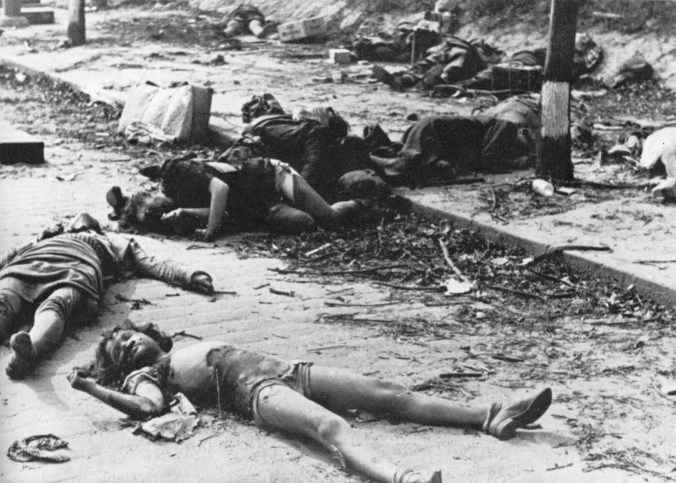
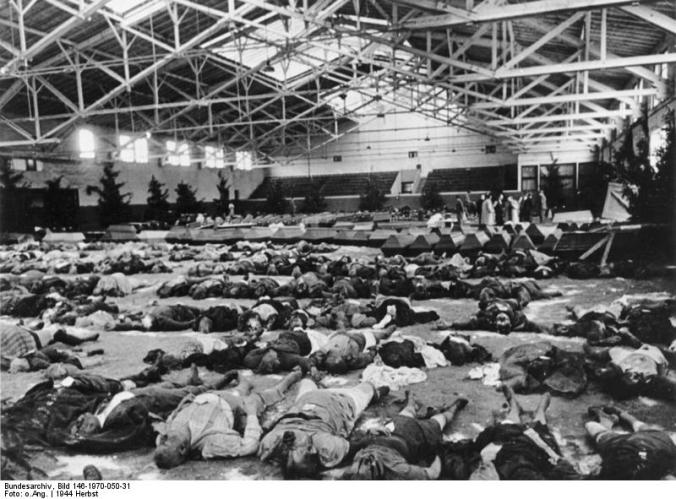
The streets were covered with hundreds of corpses. Mothers with their children, men, old people, burnt, charred, unscathed and clothed, naked and pale like wax dummies in a shop window, they lay in every position, quiet and peaceful, or tense with their death throes written in the expressions on their faces. The situation in the air raid shelters was the same and made an even more gruesome impression because, in some cases, it showed the last desperate struggle which had taken place against a merciless fate. Whereas in one place the occupants were sitting quietly on their chairs, peaceful and unscathed as if they were sleeping and had unsuspectingly been killed by carbon monoxide gas, elsewhere the existence of the fragments of bones and skulls showed how the occupants had sought to flee and find refuge from their prison tomb. Source

germany_hamburg_gomorrah_victims_in_air_raid_shelter_280x189

There is another great source (in German) which describes the multiple levels of Civil Defense in Germany. The specific chapter on the Luftschutz you can see here. My interest was never so much how they were structured but rather how they responded. What affect did continuous raids have on them? Whereas the Blitz in London last 9 months (with a second Blitz later on in the war from V-1 and V-2 rockets), German cities endured raids of varying intensity for years. Every German city of any consequence was bombed at least once. Some of the cities were as much as 80% destroyed by the end of the war. Increasingly, young women and teenage boys too young for service at the front found themselves drawn in the battle to save German cities from fires as the war dragged on.

d243d7f550a39c9c8762019d2e60f07d

I’ve been fortunate to speak to dozens of people who lived through this era. Some served in the Germany Army, but my biggest area of interest was the civilian side of it. Therefore, I’ve spoken to teenage boys who crawled into rubble to search for trapped occupants, teenage girls of 18 or 19 who learned to fight fires caused by incendiaries, and military personnel who served in what would, in a modern fire department, be called a Heavy Rescue Squad. Some of the stories they told me were humorous. Most were tragic.

fm0514_frauen_im_luftschutz

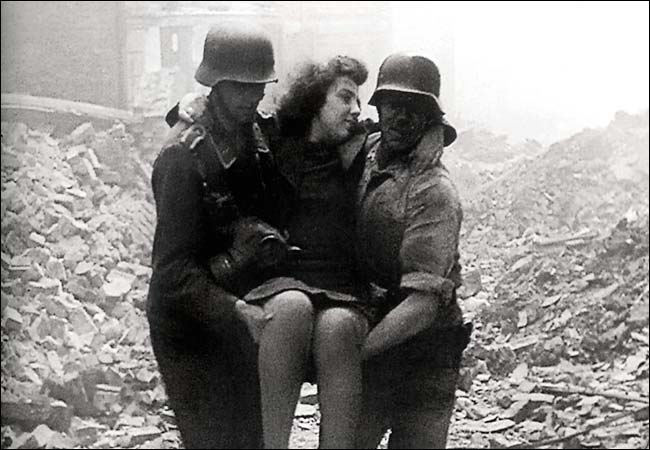
They spoke of seeing firefighters cut down by shrapnel from high explosive bombs in the midst of trying to put out a fire. Of piles of dead bodies in the streets. Of the many ways bombs can kill you. They spoke of going into shelters and seeing women and child apparently sleeping, victims of carbon monoxide poisoning. Of shelters fulled of charred human remains who burned alive from the phosphorus incendiaries designed to penetrate into underground shelters and torch the occupants. One man told me of falling into what he thought was water, only to find it was liquified human fat. He was a young boy of 13 when that happened. They spoke of fear for the safety of their loved ones while they tried to save strangers. Of hours spent digging into the rubble of a building to reach trapped occupants, only to find them all dead. The lives of the occupants summarized by a simple chalk mark on the side of the building (20 Tot). The remains to be collected later.

Berlin, Opfer eines Luftangriffes

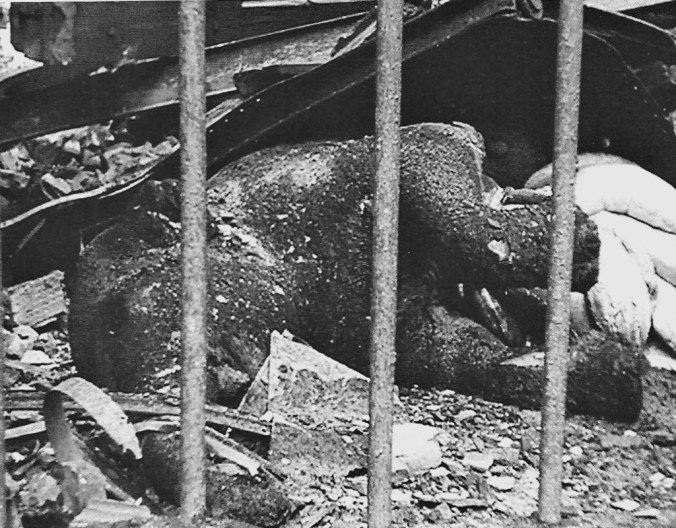
But, Dear Reader, to even discuss this invites criticism. Most will tell you they deserved their fate. I do not necessarily disagree with that. Some have called the British practice of area bombing and the deliberate targeting of non-combatants a war crime. I do not. Total War is a devastating thing. We’d do well to keep that in mind. War is not a video game. I do, however, feel sympathy for the children and the animals. Neither of them were responsible for what their government or the adults in their society did. Did a five year old child deserve to be burned alive, trapped below ground, because of what his government was doing? But they suffered just the same. The Berlin Zoo was hit during a heavy raid in November 1943 and many of the animals died. For the residents of Berlin, the dead animals led to a temporary increase in their meat ration.

8328671_orig

Dear Readers, I’m working on a book length project which compiles most of the research I’ve done off and on for twenty years. It gives a ground level view of the bombing raids Berlin suffered during the war and what it was like for the inhabitants and, most importantly, the Civil Defense and Rescue Workers. It is difficult for a few reasons. First of all, there is the language issue though thankfully I know enough German to get by. Second, I have the gnawing idea that no one cares about the subject, so why bother writing about it. Third, I have to walk a very, very thin tightrope. When describing the aftermath of a raid, if I appear too sympathetic, then I risk being called all sorts of names (Nazi sympathizer, etc, etc). But at the same time, as a historian, I also have an obligation to the truth. Therefore, my approach is to simply report the facts without judgement or observation. I just describe what happened and leave it at that. I think, perhaps, that is the best way to handle it. As I said above, I do not consider adult German civilians to be innocent victims of air raids. However, that does not somehow change the fact that firebombing raids were a horrific, horrific thing, no matter if justified or not. Maybe if we read graphic descriptions of what those raids were like, we as a society will strive to live in a world in which bombs are no longer necessary. History tells us human nature doesn’t change, so sadly, a world without bombs is not possible.

Here, Dear Reader, is but a small excerpt from a passage dealing with the raid on Berlin on the night of November 22-23, 1943. The heaviest in the war up to that point:

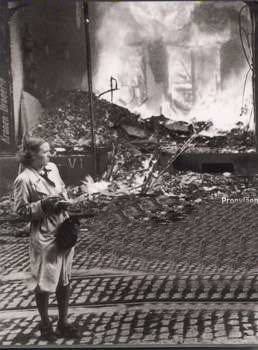
The heavy stench of smoke mingled with the sickly sweet odor of burned flesh filled the air. A young girl sits on a pile of rubble, clutching a stuffed bear under one arm and a kitten, eyes wide with terror, under the other. A group of teenage Luftschutz boys in blue-gray coveralls with helmets too big for their heads stand near the charred remains of two bodies, one a child. Cigarettes dangle from their mouths as they stare with vacant eyes too old for their young faces. When a military truck arrives, driven by a young woman in a similar uniform, they scrape the bodies off the pavement and toss them in the back. A group of firefighters spray a limp stream of water on the facade of a collapsed building as workers scurry back and forth across the pile of brick and concrete as if they were ants constructing a colony. The screams of the trapped occupants are muffled, but you can hear them from the street. Smoke curls upward from within the debris. Something inside is burning. A young boy in a Hitler Youth uniform stands in front of the hose stream to wet his clothes before he worms his way into a hole made in the rubble. No one takes any notice of the zebra, freed from the confines of his zoo home courtesy of a bomb, as it gallops down the street. Such is the nature of war.

berlin1943-4-woman-house-on-fire-air-raid

It is a difficult topic to write about, one that gives you nightmares. But I do think it is an important one. Since I’m a historian cross trained as a novelist, I take a bit of dramatic license with my descriptions, but all of them are born out by my research. Is this something even worth writing about? I don’t know. If it is worth it or not isn’t a question that I can answer. Only the reading public can. But what I do know is that it is an important topic, fraught with peril though it may be. So thank you for reading my post and excerpt. May we all learn something from the lessons the 1930s and 40s should have taught us.

Hutch