Improvise, Adapt, Overcome

111

Dear Readers,

I’ve been finding it difficult to devote any time to writing of late. There are two reasons. First of all, my teaching load this semester takes up a good portion of the day (and then you can add the two hour round trip commute and the committee meetings to it). The second reason is the severe, unrelenting pain I’ve been in since my fall last month. I already have spinal injuries, but the pain has gotten absolutely murderous over the past couple of weeks. So much so that it has started to rattle my thinking. Furthermore, I cannot sit down for more than 20 minutes or so without even more pain (which makes the commute tough). In the past, I’ve always used a standing desk to write from at home. But even that is uncomfortable now. I have been forced to adapt somewhat, and I have found something that seems to work well.

I’m writing the old school way, as in actually writing by hand. The benefits of this are numerous. I don’t have to wait until I am at home and feel like standing in front of my laptop to write. I can write in my office, in between classes, while laying in bed at night, while waiting for an MRI (like I did yesterday), or just about anywhere I go. It’s like having a portable typewriter. The major drawback is my abysmal handwriting, which I’ll have to read when I transcribe the manuscript onto the the computer. As an added bonus, I can edit while I type it up, and so the first typed draft will, in fact, be the second draft.

2222

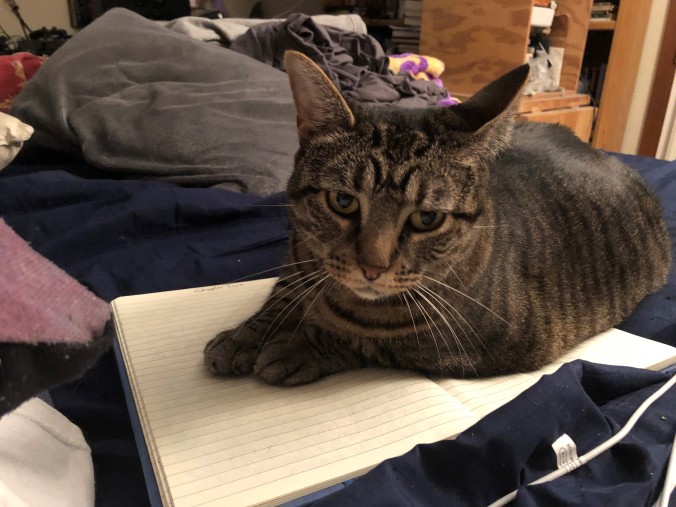
As with anything, I get “help” from Anastasia. 

It’s working well so far. It is slower going than typing a first draft though, but it isn’t like I’m on a time crunch or anything. I wouldn’t have time to type it up until after the semester is over anyway, so we’ll see how far along I am by then. Honestly, it’s kind of fun. I feel like a writer of old. I’m using a regular pen, but it would be kind of neat to use a quill and ink. I’d probably spill it all over myself though. After I hit publish on this post, I’m going to lay down on some ice packs and try to knock out a few pages. Athletes must play with pain, and writers sometimes have to write with pain.

Until next time, happy reading and happy writing friends.

L.H.

Loving Your Neighbor’s Wife: Or Lessons From Russian Lit

image

Dear Readers,

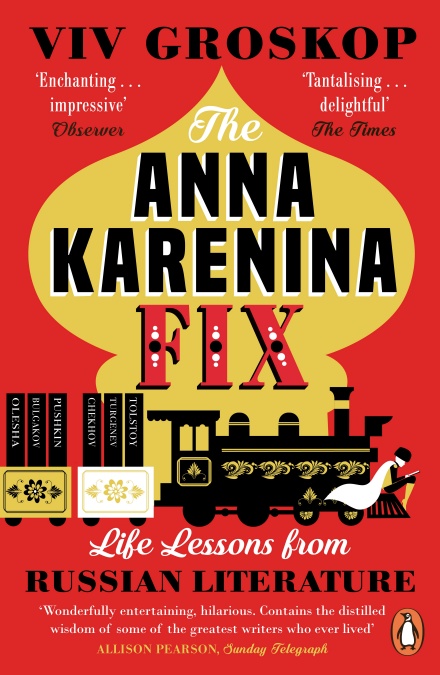
I just finished reading The Anna Karenina Fix: Life Lessons From Russian Literature. Okay, to be totally honest, I didn’t actually “read” it, I listened to the audio book. (Still counts!) The premise of the book is what caught my eye. A book that sets out to teach life lessons based on Russian literature…..what’s not to like? No one captures the human condition quite like Russian authors. As an Irishman, a people well known for our sense of tragedy, I must admit that the Russians do it even better. But I digress.

The author, Viv Groskop, studied the Russian language and literature in college and spent a year living in Russia in the early 90s. Each chapter of her book discusses a different Russian classic (and it’s author), and boils it down to its essential premise. She illustrates the life lesson with stories from her own experience in Russia. The reader (or listener) can easily apply said lesson to their own life. Such as, don’t jump in front of a train. (Anna Karenina)

If you think about it, we all struggle with certain questions in our life. Why do bad things happen? What if you love someone who doesn’t love you? What if you love someone that you shouldn’t? Is there any deeper meaning in life? Is there such a thing as fate? Luckily for those of you who are literarily (is that a word?) inclined, the pantheon of Russian lit holds all the answers. I think that at some level, most great works of literature examine at least one of these essential questions, regardless of the national origin of the author, but perhaps because of their history, Russian authors tend to do the best job. I guess a certain amount of angst is an invaluable tool for an author.

At only 224 pages, Groskop manages to briefly sum up most of the great works of Russian literature before delving into the answers to life’s questions they provide. If you add up the pages of the works themselves, it would run to thousands of pages, so this book can be used both as a primer on classic lit or as a refresher course if you’ve read the authors discussed. It’s a book that you’ll want to revisit (I’ve listened to it twice) so you can fully digest the material. Perhaps take a note or two, and then look over them should you find yourself pondering life.

My only complaint is that Mikhail Sholokhov is not mentioned. He won the Nobel Prize in 1965 and his seminal work Quiet Flows the Don is, in my biased opinion, the finest novel ever written. It was the most widely read work of Soviet literature. But, as is often the case, whether we like or dislike an author is subjective. Not mentioning him in the book may have been due to constraints of time and space. It is also true, however, that Sholokhov, fine writer though he was, is not overly popular in some circles. He was very close with Stalin. A member of the Communist Party, he was also elected to the Supreme Soviet. I’ve looked over some university reading lists for Russian literature PhD programs, and he is not even included on some of them. And that, Dear Readers, is a travesty.

So what lesson can you learn from Quiet Flows the Don? Don’t fall in love with your neighbors wife. And should a civil war break out in your country, make sure you are on the winning side.

That said, The Anna Karenina Fix will appeal to lovers of literature, both Russian and every other kind. The book has a lighthearted tone and, if you listen to the audio book, it is rather like sitting back and hearing a story. A story part hilarious and part sad (such as Groskop’s experience at a Russian funeral). So throw on your ushanka, hop on your troika, and raid your nearest bookstore. You’ll enjoy it.

L.H.

A Sweeping Historical Saga on Netflix

250px-Kurtseyitvesura-poster

Dear Readers,

This is shaping up to be a busy semester. I’m teaching six classes (five in person and one online). In addition to classroom and office time, I have my faculty council responsibilities and also, this semester, I’m on a faculty hiring committee which means more meetings and interviews. We are only two weeks in and I already feel like I’ve been beaten with a baseball bat whilst getting run over by a bus. (Most of that is due to the fall I had a few weeks back which greatly aggravated my existing back injuries.) Hopefully I’ll be able to come up for air once Spring Break gets here.

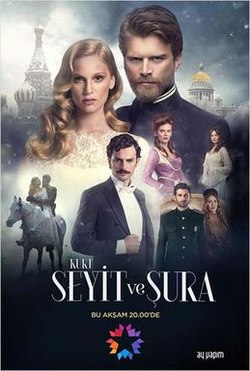
Busy though I am, I do keep my evenings free. It is a nightly tradition. I get in bed at 7pm and read while watching TV with my cat, Anastasia. (I can multi-task and so reading while watching TV isn’t a problem for me.) I am a huge fan of the period drama, British, Russian, German, you name it, I’ll watch it. I can now add Turkish to the list. I recently discovered Kurt Seyit ve Sura on Netflix and decided to give it a watch. Coming in at 46 episodes of around 45 minutes each, I probably won’t finish it before the Second Coming, but it is a binge worthy series. I don’t speak Turkish, but as it is on Netflix, it has subtitles.

I did some background reading on the series. It is based on a novel, which I am also reading. The story is actually true and is the story of the author’s grandparents who fled Russia for Istanbul following the Russian Revolution. Though the main characters are Russian, they are played by Turkish actors/actresses. I keep expecting them to speak Russian, but alas, they do not. Oddly enough, this is the first time I’ve actually ever heard spoken Turkish. It is a very pretty language.

There is something about the Russian Revolution that lends itself to drama on a massive scale. Consider Doctor Zhivago, one of the finest movies ever made. (Though the twelve part Russian mini-series version was more faithful to the book.) There is another Russian Revolution epic on Netflix right now too, The Road to Calvary. It’s excellent too. And in Russian (English subs) which lends to the ambiance. But for the full epic experience, you have to watch the 2015 Russian television adaption of Тихий Дон. I’ve sang its praises on a few occasions, and you can watch it for free here. But be warned that it isn’t subtitled.

I’m not sure what it is about the Russian past that lends itself so well to stories painted upon a massive canvas. Whether it be in print, or on screens big or small, there’s something about the county and her history that demand to be told. Perhaps it is the sheer vastness of the steppes, or the haunting beauty of Saint Petersburg. Not to mention the tragedy. There’s something about Russian and Irish authors. They seem to instinctively understand human suffering. And that translates well to film as well. For example, consider this scene where Aksinia is sitting outside the house where her lover Grishka is marrying someone else. It’ll draw a tear for sure.

I wish more sweeping epics of the American past would make their way to the screen. Back in the days of weekly television mini-series offerings, we seemed to have more of them. But it’s almost as if historical epics aren’t that popular with movie audiences in the United States anymore, despite the fact that historical fiction enjoys a steady following. Oh well, thankfully the rest of the world fills the void. I’ll keep watching Seyit ve Sura and maybe I’ll pick up a word or two of Turkish while I’m at it.

L.H.

A Disastrous Book

2513494

Dear Readers,

I finished the first week of the semester. One down. 15 more to go. Come Friday afternoon, I felt like I’d been beaten with a baseball bat while being run over by a bus. I’m afraid my fall a few weeks back did more damage to my (already damaged) spine that I’d first feared. But I’ll endure, I guess, as there really isn’t another option.

Anyway, I’m a big fan of disaster movies. The cheesier the better. I could watch Twister on an endless loop. The Towering Inferno is, in my opinion, the best disaster movie ever. Not to mention, as a retired firefighter, I appreciate how it is a stirring call to not let profit margin outweigh fire safety standards. I also enjoy reading books about disasters, both natural and man-made. That said, disaster fiction can, at times, be difficult to come by. And by that, I mean novels about actual disasters from history, not novels about disasters that might happen in the future. (Though those can be good too.)

My novel that is currently making the publisher rounds is set during World War Two. The novel I’m writing now is set during the Civil War. After that, I have a World War One novel in the mental hopper. Once those are done, I’d like to write a historical novel about some great disaster somewhere. The problem is that I can’t figure out which one to use. All that I know is that it would necessarily involve fire. The reason is because the other novels all have some aspect of historical fire protection in them. They are not part of a series and, in fact, are entirely self contained, but they all touch on the fire service. With that in mind, I’ll end up finding some major fire (probably not in the United States, but we’ll see) and writing about it.

I’m sure it will be a hot topic. And I hope the book isn’t disastrous.

Get it?

L.H.

A Fun Start to the Year

2019 started out with a bang. Last week, I fell in the bathroom and landed in a seated position. I don’t have much padding there, just back and crack. I severely bruised my tailbone but worse than that, I jarred my existing spinal injuries really badly. Severe pain doesn’t begin to describe it. But I got a 9.5 from the Russian judge. I’m not super religious, but in times like these I recall a line from a hymn that says “Whatever my lot, thou hast taught me to say, it is well, it is well with my soul.”

This isn’t quite how I wanted the year to begin, but fear not. I’ll improvise, adapt, and overcome. It takes more than pain to keep this mick down.

Seeing it on the Radio

radio-family

Dear Readers,

I have previously written about my affection for the spoken word of the radio for sporting events over that newfangled television contraption. I have a collection of old game broadcasts, old time radio shows, commercials, news, etc from the Golden Age of Radio. It actually proved quite useful to me when I was working on my novel as I could listen to what the news was on any given day. Things like that you can work into the novel as background noise, as it were. To me, the greatest radio call of all time was in the second Schmelling v Louis fight. When the announcer proclaims “Schmeling is down! The count is five!”, you can almost here the collective gasp of millions of Americans on the edge of their seats wondering if he’d stay down. (Spoiler alert: He did.) You can listen to the exact same broadcast from that night in 1938 here. Now, my personal favorite is from the final out of the 2004 World Series. As a Red Sox fan, I am a bit biased. Hearing Joe Castiglione with the final call: “It’s a ground ball stabbed by Foulke. He underhands it to first and the Red Sox are world champions! For the first time in eighty-six years, the Red Sox have won baseball’s world championship! Can you believe it!” I still get goosebumps just thinking about it.

It should come as no surprise then, reader mine, that I also enjoy old time radio programs. I’m a big fan of the Radio Classics channel on SiriusXM (and no, this is not a paid advertisement.) So I got to thinking about which OTR programs are my favorite and why, and I thought I’d hit you with another of my favorite things lists. So here we go. My favorite OTR shows.

talesofthetexasrangers&scale=5

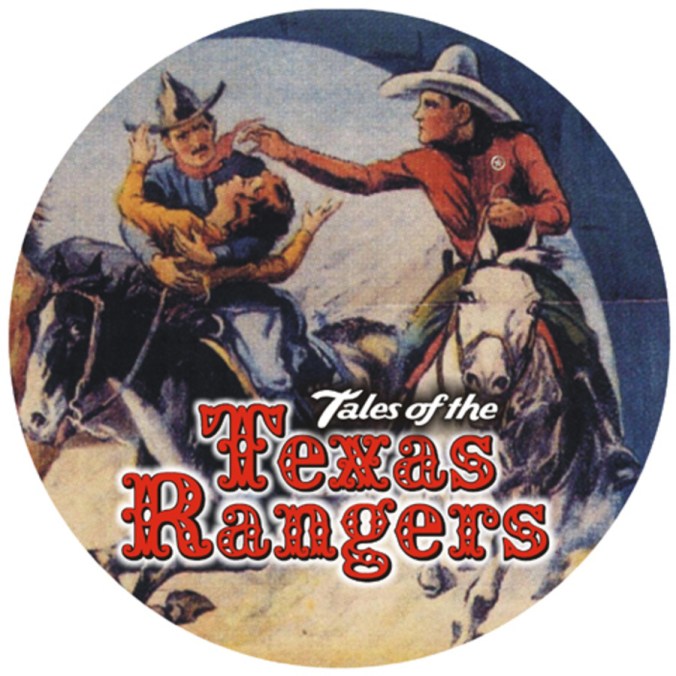
My all time favorite program is Tales of the Texas Rangers. Each episode details a case which takes place anywhere from the 30s to the early 50s. It details the actions of Ranger Jayce Pearson as he tackles crime across the State of Texas. It is a bit formulaic, as many OTR programs were. He’s usually called in to investigate a case beyond the abilities of the local authorities. There’s at least one scene where he rides off on his trusty steed Charcoal. Many episodes end in a fight or shootout, and he seems to get shot quite a bit, but don’t worry, he pulls through! I’m not sure why I like this one so much. It was only on for a couple of seasons. Maybe it is because I live in Texas. Maybe it is because I’ve known some actual Rangers. Who knows? One thing I can say is that it is great entertainment.

5786e631736b2__the-gunsmoke-radio-cast

A publicity still of the radio cast. Note it is not the TV cast.

What can I say about Gunsmoke that hasn’t already been said? It’s the granddaddy of all OTR westerns. It launched the TV series and, in fact, continued to air on the radio for a while even while the television version was gaining traction. It could be because I have something of a crush on Miss Kitty. Anyway, what I like about this show is that it does not always have a happy ending. Sometimes, bad things happen and bad people get away with it. Furthermore, it does not shy away from controversial topics. (Alcoholism, spousal abuse, prejudice, etc) It was billed as an “adult” western. By that, it means it was for the enjoyment of adults, not that you had to go into the backroom of a seedy video store to listen to it. I urge everyone to listen to at least one episode. Odds are, you’ll get hooked.

dragnet

Just the facts, ma’am.

Dragnet. Joe Friday is the man! Fighting crime and selling cigarettes! (Dragnet was brought to you by Fatima, America’s best long cigarette.) The radio program started in 1949 until 1957. It launched two television versions (50s and 60s) with Jack Webb playing Joe Friday on screen just as he did on the radio. It’s a noire=esque program with dark nights and dark deeds commonplace. It also tackles serious issues, such as the tragic episode about a young boy who finds his Christmas present early (a .22 rifle) and accidentally shoots and kills his friend. One thing that I find of great interest is that during the first season, each episode was dedicated to a police officer who died in the line of duty. The episodes signed off with giving the officer’s name, agency, and date of death. (Mostly during the 30s and 40s). I wonder why they abandoned that format going into the second season.

escape

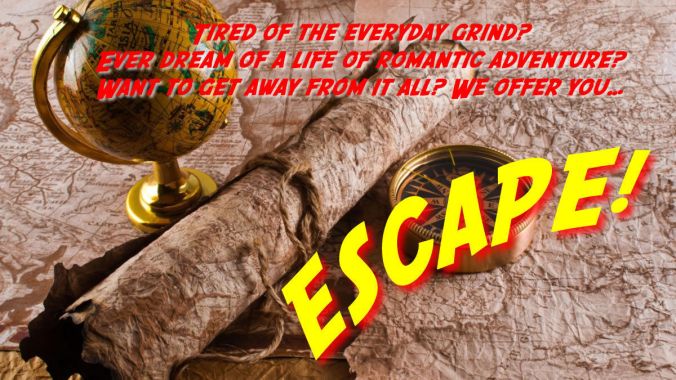
Tired of the everyday grind? Want to get away from it all? Do you dream of a life of romantic adventure? We offer you…..Escape! (cue dramatic music) That’s how this great action/adventure series begins. It rain from 1947 until 1954. Most episodes start with a person in a serious life or death situation and explain how they got there and how they extracted themselves. Many episodes were based on short stories, so if you listen, you’ll see some familiar story lines if you know your literature. It really is a great show to kick back and listen to, and it definitely lives up to its name. You’ll find yourself lost in exotic locales and, at least for twenty-five minutes, it provides you with some Escape!

So there you have it, Dear Reader. These shows are all over the internets, so you can find it for free to listen to if you are so inclined. But I’ll make another proposition. For those of you who watch football, try listening to the Super Bowl on the radio instead of watching it. I will. Even if my Saints are in it. Especially if my Saints are in it. When baseball season finally starts up again (seriously, can it start already), try listening to one game for every four that you watch. I think you’ll enjoy it.

L.H.

The Wildest Ride Yet: My 2018 in Review

Dear Readers,

New Year’s Eve is the time to reflect on the previous year and, in my case, it was perhaps the most momentous year of my life. If not that, it was certainly the biggest roller coaster that I’ve ever ridden thus far in my 40 years. I’ve struggled with trying to find a way to sum it all up, but I think I’ve gotten it down. So without further delay, here is my 2018 Year in Review, presented in word and picture.
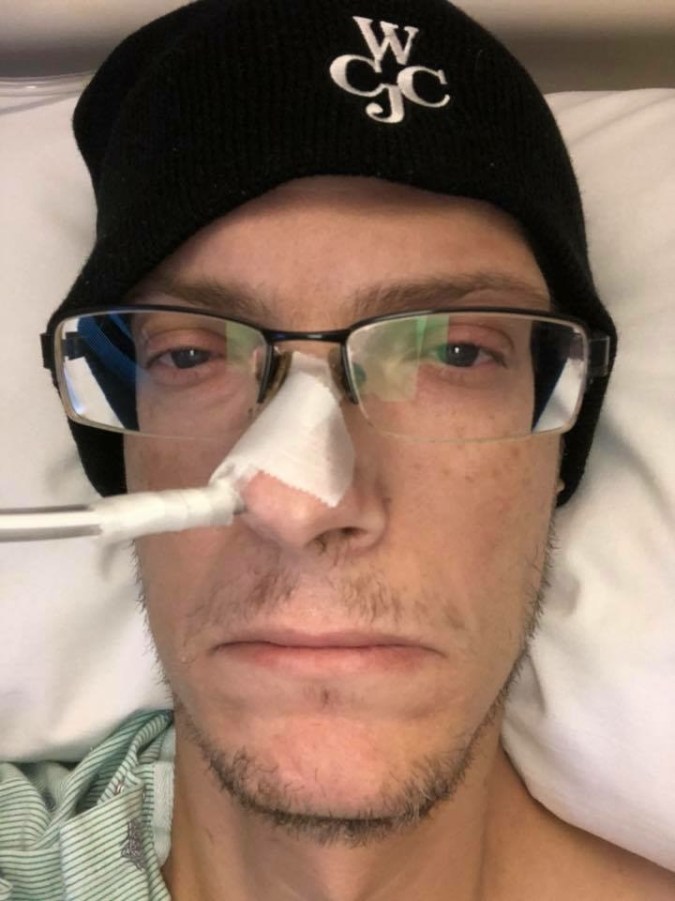
1

The morning after surgery. One word. Pain.

If you read my 2017 Year in Review post, I referenced having been hospitalized on Thanksgiving with an obstruction in my small intestine. As they did not know the exact cause, they could not say with certainty if it would return. Well, as you can probably guess, it did. In mid-January I did the usual in-service week stuff for the college before starting my temporary full time professor job. It was the usual meetings, professional development, and convocation. The weekend before classes started was a long one, with Monday being the MLK Day holiday. Everything was set for me to start classes on Tuesday. Sunday, however, I began to feel the familiar pressure/pain in my stomach. I gave it some time, thinking it might ease up on its own. It didn’t. By 2 a.m. I was vomiting and so back to the ER we went. The diagnosis didn’t take long. It was another obstruction. Owing to a flu outbreak, I was unable to get into a room until Wednesday morning and spent the time in the ER instead. On Wednesday, the surgeon saw me and said I was booked for a rather large operation on Tuesday. I spent the time in between roaming the halls with my IV pole and visiting with the nurses. I was unable to eat anything, but that had me on TPN through a Picc line, but I still dropped a massive amount of weight, bad because I’d already lost a lot due to the issue in November. The surgery turned out to be a shorter operation than they thought it would be. I had a few complications post op, and so it was quite a while before I got to go home. On the day of my discharge, I had been in the hospital for nineteen days.
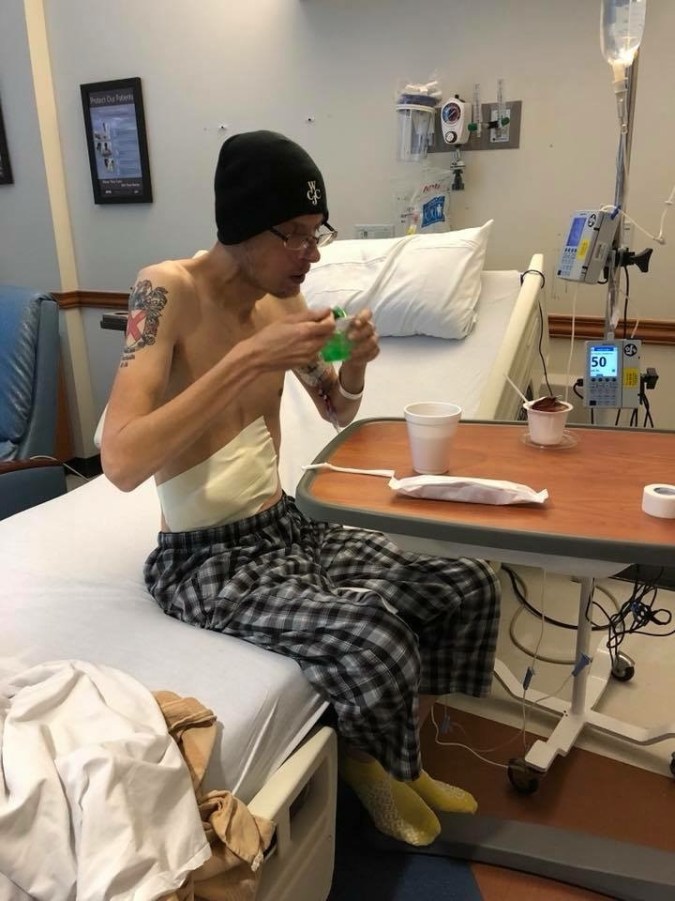
2

My first “meal”. Forgive the skeletal appearance. This is what happens when you drop fifty pounds due to stomach/intestinal issues!

I started to work officially on Monday, February 5th. I think my students were surprised to see that I actually existed. I owe a big thank you to my colleagues who covered my classes for me until I was able to healthy enough to come back. Throughout the month of February, I never felt entirely “right”. My stomach still bothered me from time to time. I was still dropping weight. Finally, by February 28th, I felt more normal than I’d felt since November. So imagine my surprise on March 2nd, our tenth wedding anniversary, when I ended up in the ER with, you guessed it, another bowel obstruction. I was only there for a week this time, but I was told that I needed the big surgery now. My surgeon agreed to let me try and make it until the semester ended. Also, while in the hospital I had a phone interview for a permanent position at the school and the week after I got out, an in-person interview. Luckily, I got the job.

5

Professing…..1940s style!

The rest of the spring passed in a blur. I spent the time teaching, watching TV in bed at night, and editing my novel which I completed in 2018 in preparation for sending it to a professional editor in August. Before I knew it, final exams were over and it was time for the surgery. They weren’t lying when they said it would be a big operation! I was in the hospital for 8 or 9 days afterwards, but did okay. I was up walking around as fast as they’d let me, though it hurt like hell as I had a six and a half inch incision in my abdomen. I weighed 130 pounds upon discharge. Keep in mind, I’m 6’4 and weighed 185 before this all started back in November! Thankfully, as I’m writing this, I’m back up to 160, though gaining weight has proven to be difficult. All these months later, I feel decent. I’m sincerely hoping I never half to go through anything like this again. But only time will tell.

4

Your’s truly on TV.

Enough of the health stuff! In June I visited the Metropolitan Research Center in Houston to delve into the archives they had on the Gulf Hotel Fire of 1943 which killed 55 people in Houston. I was able to successfully track down the mass grave where the unidentified victims were buried, and set out to see if I could get funds to place a marker. A reporter from KPRC was kind enough to air a story on it close to the anniversary of the fire. I was able to get a little support, but what I’m doing now is exploring the process for getting a historical marker on the site of the grave. That will be an easier and cheaper option.

In August, my book went off to the editor for a developmental edit. I spent much of the fall semester working on the revisions she suggested. It took a bit of time and a few more drafts, but in December I sent it back in for the copy edit. Those revisions have been done and round two of the copy edit is scheduled for Jan. 7th. Once that is complete, it will be submission time. I have a small number of indie presses to query and if I strike out, then I’ll go the self-publishing route. Be warned. I’m planning to throw one hell of a 40s themed launch party when the book hits the market, whenever that might be. (Sooner if I do it, longer if a press does it.) Also on the writing front, I’m halfway through my second novel which is set during the Civil War. That one should be ready to publish by early 2020.

Anastasia

Anastasia provided editorial “assistance.” 

As a Red Sox fan, I would be remiss if I did not mention their having won the World Series. It was an exciting summer for sure. On those long summer evenings, my wife and I always sit outside and listen to a game on the radio. Thankfully with SiriusXM and their handy app, I can get the Red Sox home radio feed on my phone or in the car. That’s useful when you live in Texas and not Massachusetts. Given the tendency of the Sox bullpen to blow saves, my sense of delight at winning the Series was only exceeded by my sense of shock. The New Orleans Saints are having a banner year too. So let’s hope at this time next year, I can talk about how they won the Super Bowl.

7

Votes for women!

When the new semester started in late August, I got to teach an in-service session on how to communicate emergency procedures to your students. I think it went pretty well. Or at least I didn’t get any feedback that said “you suck”, so I’ll take that as a win. It was kind of an odd semester, and I never really felt like I’d hit my stride. I’m not sure why, exactly, but that is how it was. In December, my wife and I attended Dickens on the Strand in Galveston with a friend of mine. We drank beer, got our picture with a suffragette, ate fried food, and had to have my wife drive us home after having too much fun. At the end of the semester, I got a “present” of sorts from the college. A new office!

8

An office with a view.

My back injuries still hurt, and always will. A little more with each passing year, but such is life. I would say I’ve gotten used to it, but there really isn’t a way to get used to living with severe pain, though you can learn to cope with it. So I’ll still enjoy my New Year’s Eve brandy and cigar on my front porch as I ponder the past year and wonder about what the upcoming year will hold. I’ll spend New Year’s Eve and Day watching the Twilight Zone marathon on the SyFy Channel, which has become a tradition since I no longer have to work holidays.
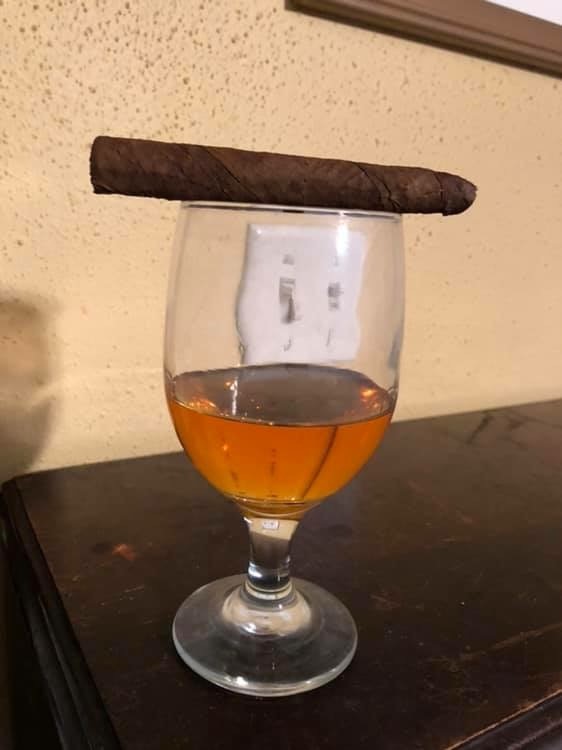
9

A brandy, a cigar, and a dream of the future.

So there you have it, Dear Readers. My wild and crazy year. I don’t do the whole “New year, new me” thing. In 2019, I’ll be the same profane, sarcastic prankster that I’ve always been. I do have some goals, though. Fortunately, they are all obtainable. They are as follows:

  1. Publish So Others May Live
  2. Finish Book Two (as of yet, untitled)
  3. Edit Book Two

Here’s wishing you a safe and happy New Year.

L.H.

The Greatest Game Ever Played

ny.1958.ameche
In 1958, the NFL was no where near the mega sport that it is now.  College football reigned supreme, especially in the South where there was a lack of NFL teams.  This was two years before Lamar Hunt created the rival AFL that would one day merge to give us the modern NFL.  Baseball still ruled as America’s pastime having surpassed boxing for our most popular sport by the late 1930s.  All it took was one game to capture the imaginations of the country, and damn, what a game.
NBC carried it live throughout the country though, for some reason it was blacked out in New York City!  An estimated 45 million people watched the New York Giants battle it out with the Baltimore Colts.  (For you new football fans, I’ll try to explain briefly.  The Baltimore Colts moved to Indianapolis and became the Indianapolis Colts.  Then the Cleveland Browns moved to Baltimore and became the Ravens.  Then Cleveland got a new team also called the Browns!)
Both teams stumbled through the first half which ended with the Colts up 14-3.  It looked like they would cruise to an easy victory in the second half.  But the Giants had other plans.  They stormed back and took the lead late in the game.  While up by 3 points with two minutes left on the clock, the Giants punted the ball and the Colts took over deep in their own territory.  Unfortunately for the Giants, the ball was now in the hands of the great Johnny Unitas, one of the greatest quarterbacks to ever sling the old pigskin around the gridiron.  The Giants defense, led by famed linebacker Sam Huff, forced a 3rd and 11.  Unitas completed a pass and then followed it up with a few more.  With seconds left on the clock, the Colts kicked a field goal to tie the game and force overtime.
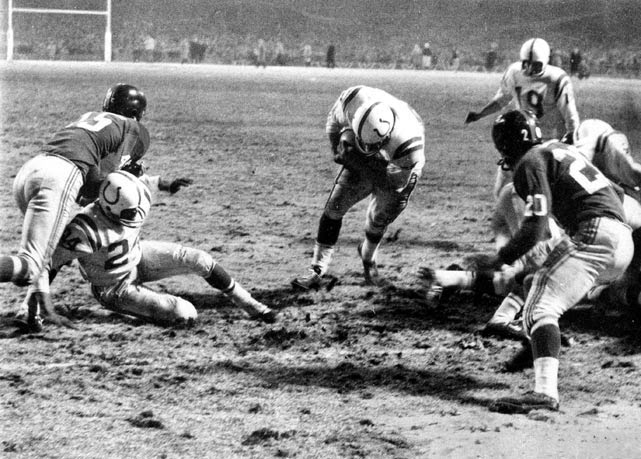
And therein lies the problem!  No NFL playoff game had ever been decided by overtime, much less the championship game!  The captains met at mid-field for the toss, just like they had at the beginning of the game.  The Giants won the toss and received the ball, but could do nothing with it.  They punted and the Colts took over.  Again, Unitas put on a football clinic as he drove 80 yards in 13 plays.  The Colts faced a third down on the Giants one yard line.  They called a simple play, really, the old fullback dive.  Alan Ameche took the ball and plunged across the goal line as camera bulbs flashed.  The image (seen at the top of the post) is one of the most iconic photographs of any NFL game.  Ever.
The NFL had arrived.  The merger of football and television was as significant as the merger between baseball and the radio.  Though it took time, the NFL would take over as America’s dominant sport.  The 1958 NFL Championship Game would go down in history as the “greatest game ever played”.
Though no full game video is out there to watch, you can listen to the complete game here along with seeing some of the game footage matched up with the radio call.

Of Books and Burns

Friends,

As I’ve previously written posts about my favorite books on topics as diverse as the Old West and the great works of Russian Literature, I thought I would turn my attention to another subject near and dear to my heart; the fire service. Novels about firefighting are not all that common, and indeed, only one makes my list here. Part of it is because the job isn’t simply rushing from one emergency to the next, which does make for exciting reading. For a novel to be realistic, it would have to cover training time, meals, and sleeping. Hardly compelling stuff. Furthermore, raging structure fires are not as common as they once were, and professional firefighters today spend more time running EMS calls than they do putting out fires. So the books that follow are mostly non-fiction memoir type books, with the exception mentioned above. These are not technical books about the job, but rather books about either the history of the fire service or the experiences of someone in it.

81qP0YSFj+L

The Bronx was burning before I was born. The men of Engine Company 82 fought a never ending battle against the red devil, responding to numerous fires each shift. Dennis Smith, a firefighter on Engine 82 also happened to be a talented wordsmith. His memoir, Report From Engine Co. 82 is a firefighting classic. Imagine if, rather than writing about World War One, Remarque wrote about life at what was, at the time, one of the busiest engine companies in the world. And that’s what this book is like. It is, perhaps, the greatest of all the firefighting memoirs and rises to the level of true literature. Smith wrote many books, including a novel called A Song For Mary which tells his story before he joined the fire department. He has also made contributions to fire service history. His History of Firefighting in America is an excellent, if somewhat hard to find these days, book. Recently, he penned a great book on the San Francisco earthquake and fire of 1906. But Report rises to the top of the crowded field of fire department memoirs.

51438XuI0RL._SX373_BO1,204,203,200_

In graduate school, my research focused on the German Civil Defense system during World War Two.  I had the opportunity to interview German firefighters who worked during the firebombing raids from 1943-45. This ignited, pardon the pun, in me a lifelong interest in how fire departments cope with the strain of wartime conditions when they find themselves on the front lines. Burning Issues is a unique account because it describes the activities of the Belfast Fire Brigade during the early years of The Troubles. No other fire service in Europe or America has had to cope with what the Fire Service of Northern Ireland has. For thirty years, terrorism tore their relatively small country apart. As part of the establishment, the fire brigade tried to stay above the sectarian issues which divided the country, and responded to calls from both communities. The author does an excellent job writing about what it was like working in that kind of environment. This is a tough book to get a copy of now, but if you can find one, buy it.

51ZqgAFReqL._SX322_BO1,204,203,200_

Larry Brown was a retired firefighter turned novelist from Oxford, Mississippi. His non-fiction book On Fire is a short but very interesting account of his time as a firefighter. It consists of a series of short vignettes which move from the humorous to the tragic, a fact which I think all of us current or retired firefighters can relate to. With a novelist’s skill, he tells stories which induce laughter and/or tears. Reading this book is rather like sitting around a campfire and listening to the author tell stories. It’s personal and engaging. Sadly, the author passed away several years ago, but he has left us with a great account of firefighting in the Deep South in the 70s and 80s. I’m sure William Faulkner would approve of this book.

71aNDy9kgDL

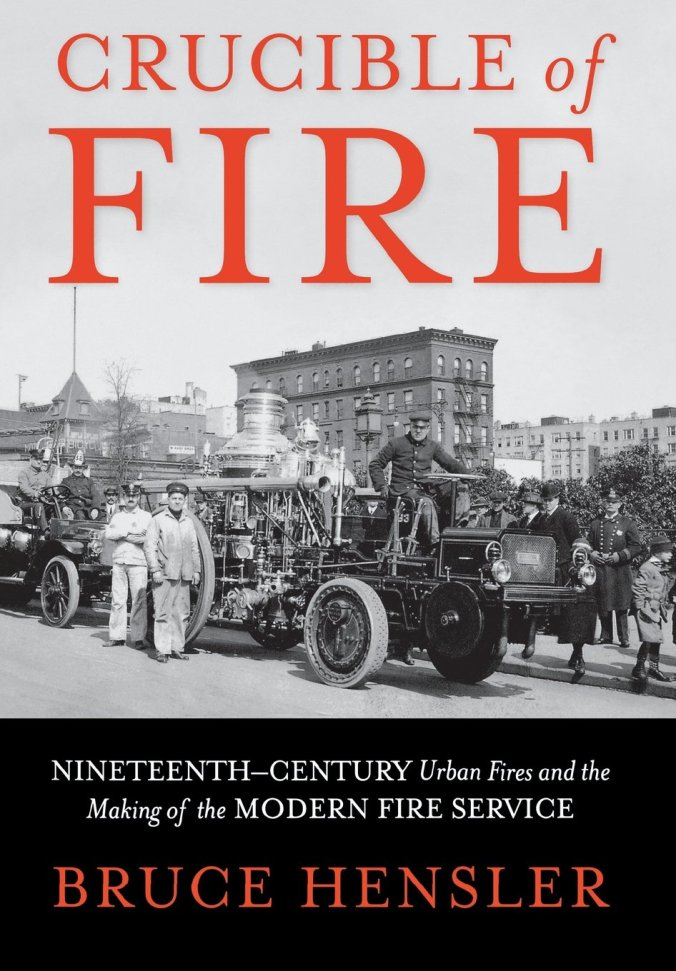
If you are in the market for a more scholarly look at the development of the American Fire Service, look no further than Crucible of Fire. The author describes some of the great conflagrations of the 19th Century and explores how they impacted fire departments of the 20th Century. It’s about lessons learned and applied. As such, it might not appeal to the general reader, though firefighters, historians, or both will find much to like about it. Firefighting in the United States is long on tradition unimpeded by progress, so sometimes it is nice to see where some of those traditions came from. Fire departments are made up of humans, and as such, we tend to learn from our mistakes, thus finding things out “the hard way”. This book is a great read for young firefighters, who I think need to know some of our shared history, no matter how boring it might seem to them. The fundamental goal of firefighting, putting the wet stuff on the red stuff, has never changed, even though our apparatus and gear has.

41rqlQbyN4L

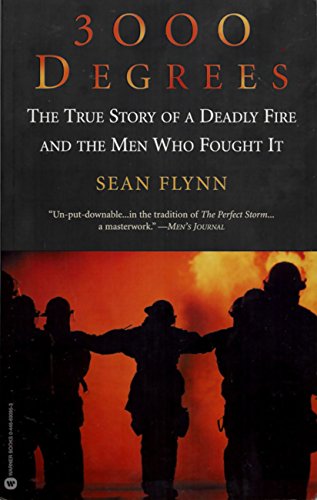
3000 Degrees is the best book written on a single fire and the men who fought it. The author tells the tragic story of the 6 firefighters killed in the Worcester Cold Storage Fire in December of 1999. I was a young firefighter in Texas at the time, and I remember watching the news coverage of this fire. What the author does particularly well, is introduce you to the lives of the six men, so that when the unfortunate events occur, you can really feel the loss suffered by their families. It’s far more than just the story of a fire, it is an ode to those who answer the alarms, even knowing the risks they face. Not a terribly long read, it can be easily digested. It is also available as an Audiobook with an excellent narrator, so if that is more your cup of tea, you can enjoy it that way.

417PHBROo9L._SX331_BO1,204,203,200_

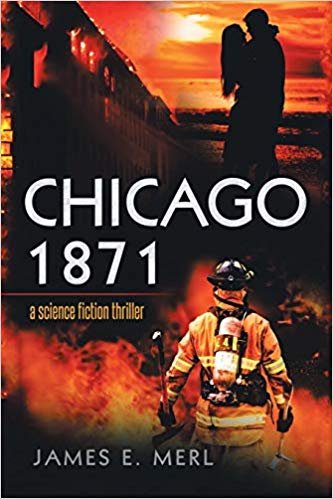
My final book is the only work of fiction on the list. Chicago 1871 is both a science fiction novel and a historical one. The science fiction angle comes from the fact that the protagonist travels back in time to Chicago on the eve of the Great Fire. While I actually don’t much care for time travel books, this one is the exception. Once we arrive in the past, the author does an incredible job painting a portrait of the Chicago Fire Department in the 19th Century. The information about how they lived and fought fires is well researched enough to be like reading entertaining non-fiction. The action scenes are very well done, and you can almost taste the smoke. I’m a first generation firefighter, and my son has no desire to enter the profession and so I’ll be the only generation, and I have no personal connection with the firefighters of old, other than a shared job. Sometimes, the book made me wish I had worked back then instead of when I did. But to work back then, I’d have to live back then, and I rather like having access to antibiotics. There aren’t many firefighting novels out there, but this one is the best I’ve read. Feel free to check out the author’s page here.

So there you have it, Dear Readers. Hopefully you’ll check out some of these books and find them as interesting as I did. Being a firefighter is the toughest job you’ll ever love. My years on the job made me the person I am today, for better or worse. Until next time, enjoy your holidays and I’ll see you at the big one.

image1 (1)

L.H.


Writing Off Into the Sunset

315c7d4cbca8915596ca4cb76669e411--lonesome-dove-silver-anniversary

Howdy Partners,

I must say that Red Dead Redemption 2 is turning out to be quite the gaming experience. It’s a bit more involved than the first game was, but that isn’t a bad thing…as long as you remember to feed your horse. I’ve always been a fan of Westerns, both print and screen. Perhaps that comes from growing up in Texas. I drive a truck. I have a nice pair of rattlesnake skin boots. We even had a horse when I was a kid. I love riding horses. I draw the line at wearing a cowboy hat, though when I worked for Texas Parks and Wildlife, I had to as it was part of the uniform. I grew up watching old westerns on TV, mostly B movies with thin scripts and bad acting. But at least you could tell who the good guys were. They wore the white hats! Who hasn’t dreamed of galloping off into the sunset on a trusty steed with a redheaded saloon girl sitting behind you in the saddle. Okay, maybe that’s just me. Before I digress further, I will now give you my favorite western novels.

3ed96186d0d9f4b4becf1234bcd9696b

Lonesome Dove. What can I say about it that hasn’t already been said. If you want to learn how to create vivid characters, read this book. Captains Woodrow F. Call and Augustus McCrae leap off the page and into reality. In my mind, they are real people. (Note: I see myself as being more like Augustus, but my wife insists I am like Woodrow F. Call…..something about being stubborn……). I first read the book in the late 80s, after I watched the mini-series. I think I was 10 years old or thereabouts. It is a relatively straightforward story about a journey from Texas to Montana, but three is nothing simple about the complex web of characters that populate the pages. I remember sitting in an undergraduate creative writing class and the professor asked us what we thought the greatest American novel was. I gave my opinion that it was Lonesome Dove. The professor sneered and said “Westerns aren’t literature.” I replied “Well the Pulitzer Prize committee disagrees with you.” Needless to say, my grade suffered as a result. The fact that the professor who so readily dismissed the greatness of Lonesome Dove had not published anything himself was not lost on me. If you only read one western in your life, read this book. If you only watch one western movie or television show, watch this one.

51cV7-VGuqL._SX331_BO1,204,203,200_

The Son is a remarkable book that follows story lines set in three eras. 1840s Texas. 1915 Texas, when Anglo ranchers fought a nasty border war with Mexican rebels. 1980s Texas, where oil reigned supreme. This book doesn’t skip over the violence, and it is full of action. It is also the best fictional description of life among the Comanche that I have ever read. You’ll learn quite a bit about their life and beliefs from this novel. The chapters that deal with the Texas/Mexico border during the Mexican Revolution shed light on a little known conflict that still affects the relationship between the United States and Mexico today. The patriarch of the family, and the driving force of the narrative, is an all around badass. It is a book that tells the history of a state, a family, and a people. As an added bonus, A&E made a television version as well which is pretty faithful to the book. I’d classify this as a must read for all Texans or those who wish they were Texans.

340210

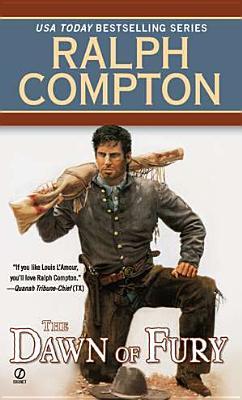
Ralph Compton was one of the godfathers of the western genre. His Dawn of Fury (and the subsequent sequels) are among my favorites. They are perhaps not quite as literary as the two books above, but they are action packed and a throwback to the old dime novels. The story involves a former Confederate soldier and his search for those responsible for killing his family in the waning days of the Civil War. With his trusty hound Cotton Blossom, he roams the West dishing out revenge and meeting all sorts of interesting characters, some of them historical (such as Doc Holiday). Admittedly, the books do stretch credibility a little bit, especially when the main character manages to get shot just about every third chapter and yet always manages to survive, despite living in the era before antibiotics. However, that is a small fault and does not detract from the story. The novels in this series are an immerse tale that gets you lost along the dusty trails and boom towns of the Old West.

So, partner, saddle up your horse and gallop, don’t trot, to your local library and read these books. They are perfect company on those lonely nights out on the trail. Just be careful that some low down varmint doesn’t steal them from your saddlebags!

I realize that there are many other wonderful westerns. (The Virginian, True Grit, Riders of the Purple Sage, Blood Meridian, etc) I do not mean to detract from any of them. My top three is exactly that, mine. Your mileage may vary.

Until next time, Happy Trails,

LH