The Big Fellow

e20f663022cf7acd4fe8143312bdd7a1

Throughout the long history of the British Empire, her most troublesome colony was the one closest to it.

Dear Readers,

I must confess a great crime. I am, indeed, guilty of conduct unbecoming an Irishman. Despite 9 years of marriage, I have failed to require my wife to watch Michael Collins. As she is not Irish, but rather German, this should have been a condition of our engagement. I have but two heroes of the historical variety; General Sam Houston and Michael Collins, Minister for Finance and Mayhem, among other things. Both have quite a bit in common, believe it or not. The Redhead did read a Sam Houston biography whilst we were dating and surprised me on our wedding day by having the inside of my ring inscribed with the word “Honor” so that I could have a ring just like the one wore by Big Sam Himself. Naturally, she knows that I revere Collins as I speak of him often, but I never got around to showing her the movie which, for all its historical faults, and there are many, still manages to be quite good.

To me, the most remarkable thing about The Big Fellah is what all he managed to achieve in such a short period of time. He was 25 when he fought in the GPO during The Rising and died in an ambush, killed by a fellow Irishman, at the age of 31. Journalist and perhaps Ireland’s greatest historian Tim Pat Coogan called him “The Man Who Made Ireland”. This is a fair assessment. From his vast intelligence network to his direction of “The Squad”, Collins helped achieve something that Ireland wanted for centuries. Did he get the Republic he longed for? No, but as he said, the Anglo-Irish treaty gave Ireland the freedom to achieve freedom. Did he sell out the North? Not really. He tried to ensure fair treatment of Catholics in Ulster and, in fact, towards the end of his life sought to ensure the IRA in Ulster could continue to operate if need be.

Was he a terrorist? I guess that depends on your perspective. A stronger country who occupies a weaker nation always refers to those who fight back as terrorists. Consider, however, the conduct of the British Army and the Black and Tans in Ireland. From gunning down innocents in the streets to massacring spectators at a GAA contest at Croke Park, they behaved in much the same way as Collins’ boys, yet somehow they only consider Collins to be the terrorist. The conduct of the British in Ireland from Cromwell through the early 1920s should illuminate who the real terrorists were. Collins understood what doomed all previous Irish attempts to free themselves to abject and bloody failure; traitors and informers within their midst. For this reason, he used his squad to decapitate Dublin Castle’s ability to gather intelligence. It’s a nasty business, war. Especially wars for liberation. In a relatively short period of time, Collins and his boys brought the world’s mightiest empire to its knees and invented modern urban guerilla warfare in the process. “There is no crime in detecting and destroying in wartime the spy and the informer. They have destroyed without trial. I have paid them back in their own coin.” His tactics were severe, but effective. It’s all the British government would understand at the time. It is sad that it had to come to this, but the British were never going to leave unless they were forced to.

Collins probably knew Dev was setting him up as a scapegoat by sending him to negotiate the treaty. The British could not fathom why the Irish did not want to be “British” and there was no way in hell they were going to grant them a Republic. They did, however, give Ireland a remarkable amount of self-determination as a Free State, more so than Canada had at the time. Make no mistake about it. Collins knew the treaty would not be popular at home. He is reported as having said “Think what have I got for Ireland … Something which she has wanted these past 700 years, will anyone be satisfied with this bargain, will anyone? I tell you this, early this morning  I have signed my death warrant.” His words turned out to be prophetic. De Valera opposed the treaty and thus Ireland fell into a terrible Civil War where former comrades fought against each other. Mick lost his trusted friend Harry Boland and then his own life.

 The Big Fellah’s shadow still looms large over Ireland. He is, perhaps, Ireland’s greatest figure and one of the important figures of the entire 20th Century. Incidentally, whilst his squad popped G-Men on the streets of Dublin, his brother Paddy served as a police officer in Chicago! On his deathbed, Collins’ fathers told the family to take care of 6 year old Michael as he’d be a great man for Ireland one day. Indeed he was. And still is. I shall leave you with one more quote which sums up his feelings for his country:

 “Give us the future. We’ve had enough of your past. Give us our country to live in. To grow in. To Love.”

 If any of you are interested, I made a Twitter account for him as he lacked one. So you can see his comments on himself and on current events. You can find him here: @thebigfella1916

Hutch


Reaping the Whirlwind (Pt. 4)

image1

Dear Readers,

I’ve reached the 1/3rd point of my work in progress. It’s been a mixture of slow and fast going. I write much slower now than I ever have before. When in college, I could dash off 10 pages in a matter of an hour or two. Now, my 3,000 word a day limit sometimes takes me the better part of 6 hours to finish. Of those words, maybe half of them are actually any good. But books a rewritten more than they are written. That’s what editing is for. The important thing is to get the first draft finished. I’ve identified several issues with the overall plot and layout which will require extensive revision. I may end up cutting the four characters down to two so that I can get more in depth into them and their world. We’ll see. There is much left to write.

As I slave away in front of the computer, I have been pondering great works of World War 2 fiction that I’ve read in my life. If you are a writer, you have your favorites that influence your style and even the type of fiction you write. I’m a HUGE fan of the Dave Robicheaux series by the great James Lee Burke. Indeed, my completed novel is a mystery set in a fictitious Texas town on the Gulf Coast. It’s pretty good, actually. I haven’t take the time to revise and edit it though. I might once I finish with my current project. So please allow me a few moments to discuss my favorite World War 2 novels. For those who tough it out to the end, you’ll get to read the opening of my own novel So Others May Live. 

Bomber by Len Deighton. This is an incredibly written novel which takes place over a 24 hour time span. It details everything that went into planning and carrying out a bombing raid on the fictitious German town of Altgarten. At the same time, it also details the town itself with all its secrets and intrigue. Deighton is a master storyteller. As an added bonus, the BBC did a radio dramatization of the novel in the early 90s too, so you can both read it and then listen to a radio version of it. Both are excellent. I would tell people that if they read any novel about the Second World War, make it this one.

A Time to Love and a Time to Die by Erich Maria Remarque. Wait, I hear you saying, isn’t he the guy that wrote All Quiet on the Western Front? Yes, Dear Readers, he is. This novel is, in my opinion, perhaps better even than his best known work. It takes place over a short span of time and involves a German soldier on leave from the Eastern Front. Particularly evocative of the paranoia and claustrophobia of wartime Germany, Remarque does an excellent job showing the behavior of people in wartime. It is worth noting that Remarque’s books were banned in Nazi Germany and he fled to Switzerland. In retaliation, the Nazis arrested his sister who remained behind. At her trial for undermining morale, the judge said “Your brother is unfortunately beyond our reach but you, however, will not escape us.” She was beheaded in 1943. Remarque eventually immigrated to the United States and became and American citizen. He married actress Paulette Goddard who was both incredibly hot and a redhead. But I digress.

The Burning Blue by James Holland. A friendship. A forbidden love affair with a best friend’s twin sister. Spitfires. The Battle of Britain. They blend together in this wonderful novel to create a perfect tale of wartime England. Told through a series of flashbacks whilst the main character lies recovering in a hospital bed in North Africa, the book starts a few years before the war and builds towards an exciting climax. You feel for the main character as he lives on a razor’s edge during the Battle of Britain. You want him to get the girl and you genuinely grieve when he doesn’t. Or does he? The aerial combat scenes are magnificent as are the personal interactions between the characters. Holland is a master of aviation fiction. (See his other work A Pair of Silver Wings as well.) For fans of British period dramas (Foyle’s War, etc) or The Battle of Britain, I highly recommend this novel. If you want to find yourself behind the controls of a Spit, read this book at once.

Berlin by Pierre Frei. This is technically not a World War 2 novel as it is set in Berlin, but it is at least in the immediate post-war period. A serial killer stalks the streets and a Kripo detective is partnered up with the Americans to track him down. What is really neat about this novel is that you have a chapter about each victim that tracks their lives up until the instant they are murdered. Then you’ll have a chapter about the investigation of their death. Getting deep into the lives of the characters makes their deaths all the more tragic. The novel does an incredible job of describing post-war Berlin; the hunger, the black market, the fraternizing between GIs and German girls that wasn’t supposed to be taking place, the secrets people tried to keep about the lives during the Nazi era. The author was born in Berlin in 1930 and grew up there. First published in German in 2003, it was translated to English in 2005. Definitely read this, especially if you like murder mysteries.

Payback by Gert Ledig. “When the first bomb fell, the blast hurled the dead children against the wall.” Holy F–k! What an opening! This book is rare and difficult to get a copy of, though used copies do exist. First published in German in 1956, it was not translated into English until 1999. The author served on the Eastern Front and was sent home after he was wounded near Leningrad. Whilst at home, he experienced Allied air raids which are the subject of this novel. The book isn’t long. The whole thing takes place over the course of an hour or so in a nameless town as it is pummeled by bombs. Each short chapter tells about one person in the town. Before each chapter is short piece where the character introduces themselves to the reader. You see the raid unfold with all its macabre horror. From a 16 year old girl raped in a cellar as bombs fall to the dead unburied by explosions and hurled into the trees, Payback provides a stomach churning glance into life under the bombs. The book is controversial because British and American audiences do not generally like to read about what their bombs did. Still, this book is an anti-war classic and a must read.

Now, Dear Readers, as promised, here is the opening to So Others May Live. Keep in mind this is an unedited first draft and I cannot state with certainty that this will be the opening scene in the finished product and even if it is, it’ll probably be a bit different.

Fire. A tornado of fire. Flames shot upwards, a thousand feet or more, and turned the night sky to daylight. Wind swirled around the base of the inferno. Over the roar of the conflagration, a new sound emerged like the scream of wounded animals. People staggered over the rubble choked streets as the heat seared their bodies. Clothing burst into flame. The human torches ran in circles until they dropped to the street and lay still. The wind grew in intensity until it lifted, first children and then adults, and hurled them into the seat of the fire. They screamed and flailed in the air until the flames devoured them. Hair burned. Clothes burned. Even the streets burned. The odor roasted flesh overpowered that of the phosphorus driven firestorm. Somewhere, a bell rang.  

There you have it, friends.

Hutch

Reaping the Whirlwind (Pt. 3)

e5f87a4197186c6bdb41af4dcb4bf355

Dear Readers,

As I share my journey in writing my book, I thought I’d take the time to share a little about the research process. You can read the other parts of this series here: Part One & Part Two.  My previous completed novel is a mystery, and since I was an investigator, I know something about solving crimes. As my latest work is historical fiction, I thought it worthwhile to say a few words about how the research process works for me.

The past is like a foreign country. It has its own language, culture, and living conditions. I find it best to approach it in that way. Now, I have always had a healthy interest in the past. I don’t know exactly why, but I’ve been reading about the past since I was five years old. That’s when I checked out my first book from the library and it just so happened to be a history book. I’ve been held captive ever since. I have a personal library of 2,000 books and the largest single subject is World War Two. Both of my grandfathers were veterans of this war. My grandmothers’ brothers all served as well (one was killed). All of my grandparents’ friends either served in the war or went through it on the home front, so in a way I was surrounded by it as a child. I studied history in college not because I planned on actual doing anything with it (I was happily a fireman in those days) but because I enjoyed the subject. The same goes for my graduate degree in History. Then I changed teams and became a police officer, still with no plans to use my degree, though I started teaching part time as an second job way back in 2004. I never would’ve guess I’d get hurt. I’m still teaching, and it is still part time because I’ve been told I’m not “full time material”. But I digress.

berlin1943-4-woman-house-on-fire-air-raid

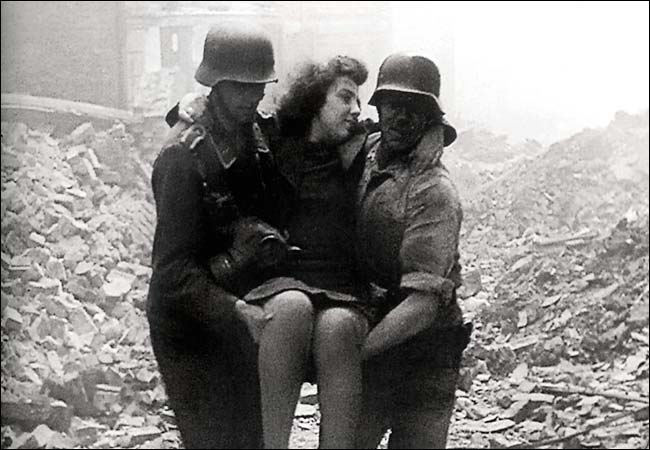
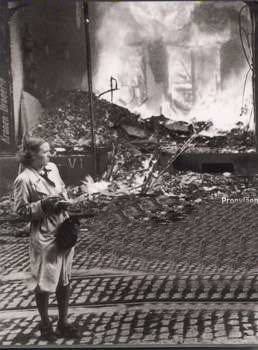
My book deals with two interconnected pieces of the war. First, is the bomber offensive against Germany, particularly that waged by the British. Thankfully there are some excellent books and documentaries on the topic. I start at the time and read general World War Two histories, then general books about RAF Bomber Command, and finish off with specific books written by people who flew Lancaster bombers over Germany. I have also consulted books on the British Home Front. Start broad and finish specific. The second piece of the book deals with the German Civil Defense system, particularly the fire brigades and how they coped with devastating fire bombing raids. This proves a little more difficult to research as there is not a large amount of material in English. For this aspect, I use interview notes I’ve complied while speaking with those who experienced the war in Germany as civilians, including some who served in the Luftschutz and/or the fire brigades. These interviews were conducted long ago, and long before I decided to write a book. I also read general history books about Nazi Germany, then books specifically about Berlin during the War (and there are some great ones), and finally the published recollections of German civilians. I’ve also uncovered some excellent training videos done by the German government to instruct civilians how to respond to incendiary bombs. For the sake of comparison, the study of the London Fire Brigade during The Blitz and of the British ARP and Civil Defense system has been important too.

p_aircrew1

Bomber Boys. 45% of all RAF Bomber Command aircrew were killed in action.

In some ways, I feel as though my entire life has been one big study session and this novel is my final exam. In that case, I hope I pass. I’ve put a lot of pressure on myself. Writing is a difficult enough undertaking, but with historical fiction I feel a solemn obligation to get it as “right” as I can. I feel I’d be doing a great disservice to the men and women who lived through this tumultuous period in our past if I fudge the truth. Maybe that’s asking too much of myself. I’ve read a lot of historical fiction where the author is so knowledgeable that they can’t help but dump massive amounts of information in a single paragraph to the detriment of the story. To help resist that urge, my motto is : “Storytelling first”. Tell the story and weave the history around it, do not weave the story around the history. But get it right, nonetheless.

fm0514_frauen_im_luftschutz

My book is divided into four parts. It takes place over the space of 36 hours and there are four main characters, one male and one female in England and the same in Germany. (There are, of course, a host of secondary characters who dance across the pages. Some for longer than others.) Each chapter is from the point of view of one character and each part has eight chapters. This is how part one is structured:

Part One: Afternoon, Sunday, November 21, 1943

Chapter One begins with Flying Officer Michael O’Hanlon, 22, as he finishes up his weekend pass with his fiance Grace. He has one more mission to reach his 30th which will give him a spell off of operations and an assignment to a training unit. They have plans to marry then. His reason for a weekend pass? The previous Wednesday he brought his plane back from a night mission over Germany with a dead top turret gunner, a dead wireless operator, and a seriously wounded navigator. His Lancaster received heavy damage and his crew got the time off to allow for repairs and to allow for replacement crewmen to be found. Now he will fly his last mission with half his crew inexperienced.

Chapter Two begins in Germany where Oberwachtmeister Karl Weber is teaching a class to a new draft of recruits. These aren’t military recruits, however. Karl is a veteran member of the Berlin Fire Brigade. One of the few men with experience still around owing to the constant drain on German manpower in Russia. Even Karl served during the early days of the war before a wound allowed him to resume his civilian occupation where he’s served since 1929. His recruits? Four young Hitler Youth boys 15-6 years old. Full of love for their Fuhrer and a belief in their own invincibility. The other four recruits are four young women who range in age from 17-20. It will be with these kids that Karl and the three older men at the station must wage a very different war than that waged by Michael O’Hanlon. While one drops bombs, the other tries to save lives amidst the rubble. Both are scared, yet they do their jobs anyway.

Chapter Three follows Grace Robinson,21, the daughter of a doctor and the only surviving child now that her brother, a Commando, was killed at Dieppe, as she leaves Michael at the train station. She can tell something is wrong with him, but she doesn’t know what. They haven’t known each other for long, just a few months, really, but she desperately wants him to return after his next mission so they can get married. Grace has not told her father of her plans to marry, much less her plans to marry an Irish Catholic from Belfast. She also harbors a deep secret, one which is alluded to, but that she won’t speak openly about. Should she tell Michael before they marry? Grace wanted to tell him while he was on leave but decided not to burden him with it before his next and hopefully last flight. Grace understands as much about Michael’s war as any civilian could. She was in London during The Blitz and knows firsthand the power of bombs. To that end, she and Ursula might get along if their countries weren’t at war.

Chapter Four introduces us to Ursula whom we briefly met at the end of Chapter Two. She’s a serious, redheaded German girl who lives on the edge of Charlottenburg in the western part of Berlin. Her parents are dead. Frau Muller died in an accident in 1937. Herr Muller, a Social Democrat who referred to the Nazis as ‘Hitler and His Circus Clowns’ died of a heart attack on the day Germany invaded Poland. This was perhaps for the best as he was spared the deaths of his two sons, both killed on the Eastern Front. Ursula got those telegrams instead. She works as a telephone operator and shares a small apartment with two other young women, also phone operators. But she nurses her own deadly secret. We follow Ursula as she delivers forged identity papers to a group hidden in a warehouse. They have another assignment for her tomorrow night. Pick up a pistol and deliver it. She leaves the warehouse, in the middle of the blackout, and reaches her apartment building as the air raid sirens begin to howl in the distance.

image1

Each of these chapters are taking place simultaneously. The next block of four chapters which finish up Part One pick up where each of these chapters leave off. My working title is So Others May Live though I am also strongly considering A Terrible Symphony which was how reporter Edward R. Murrow described a night trip over Berlin in a Lancaster ten days after this story takes place. Which one do you like best? Since I’m not finished with the book, I’d not wedded to any particular title.

Many thanks to you all for sharing this journey with me. I do not know everything there is to know about World War 2, but I do know a lot. I’d be more than happy to help anyone with their war related questions and I place my library at your disposal. If you’d like to know specific titles I’ve found useful whilst researching my novel, please ask and I’ll forward you a list.

Hutch


Reap the Whirlwind (Pt 2)

80cf81109cbb77d271a157c3b650934c

Dear Readers,

Typically I’m not a big fan of doing too much talking about a writing project as I feel it saps the creativity that one needs to actually finish said project. I’ll make an exception here, mainly since I’ve alluded to it in another post which you can find here. In fact, you might want to read that one first as it will give you some historical background. So….here is the plot in a nutshell:

Two men. Two women. One night. Michael, a bomber pilot, proposed to Grace, but now fears leaving her a widow. Grace has a secret past that could change their relationship forever, but she can’t tell him. At least not yet. A thousand miles away in Berlin, Karl, a grizzled veteran of war both war and the fire service, takes responsibility for managing a crew of teenagers, the last line of defense against British bombers. On a routine call, he meets Ursula and falls in love, unaware she holds a deadly secret of her own.  In the space of an hour, four lives clash while a city burns. Secrets are exposed and lives change forever.

That’s it, more or less. I’m not very good at writing “blurbs” like this. I’m better at the story itself or at describing it verbally. Research wise, I draw on interviews I conducted in graduate school, a whole host of books (my personal World War 2 collection numbers several hundred volumes), some excellent documentaries, and even some of my own experiences as a firefighter. Obviously when writing any historical piece, be it fiction or non, you owe it to those who lived through the events to get it as “right” as you can. Certain pieces can be dramatized, if you will, but big events have to happen as they really did. You can’t, for example, have Pearl Harbor being bombed on Dec. 12, 1945 unless you are writing an alternate history novel (and there are some great books it that genre out there).

image1

The single night I mention in the blurb above is the night of November 22-23, 1943. This was the heaviest and most damaging raid Berlin had seen up to that point in the war. Bombs fell mostly in the western area of Berlin, in residential areas. Bombs also hit the zoo. The raid left over 175,000 people homeless. In the skies above the city, flak and night fighters claimed 26 British bombers who made the nine hour round trip to Berlin and back. Some flew home badly shot up. Others flew home with dead or seriously wounded crewmen on board. By the end of the war, 45% of all British Bomber Command crews died. Few in 1943 made it to the end of a thirty mission tour.

I’m still teasing out some of the plot elements and will naturally make some changes as I go along, but I do have the bare bones of a halfway decent story. I’ve completed two novels already, neither all that great in my opinion, but I get better with each one I write. Maybe the third time will be the charm. Below is an excerpt:

A young girl sat on a pile of rubble, a teddy bear clutched under one arm and a kitten, eyes wide with terror, under the other. Two teenage Luftshutz boys in blue-gray coveralls stood over two charred bodies, on a baby. Cigarettes dangled from the corners of their mouths as eyes far too old for their young faces stared from under the brim of helmets too big for their heads. A truck arrived, driven by a young woman in a similar uniform. The boys scrape the bodies off the pavement and toss them in the back. A block away, firefighters sprayed a limp stream of water on an enormous pile of brick and concrete. Smoke curled out from amidst the debris, as did the screams of those trapped inside. A small Hitler Youth boy stands in front of the hose stream to wet his clothes before he wormed his way into the collapsed building. He emerged a few minutes later with a child in his arms. Dead. No one took notice of the zebra, freed from his cage by a bomb, as it galloped down the street.

Hutch

The Flying Lingerie Adds That Helped Win the War: How Lewd!

images

“To the German pilots honing in on our American bombers, it must have looked as though they were being attacked by a wave of flying underwear catalogs.”

            Capt. Robert Morgan, as quoted by Donald Miller in Masters of the Air, pg. 117-8.

Friends,

When you think of the aircraft that won the war, one of the first things that come to mind is the pictures of cartoons, names, or more often, scantily clad women painted on them. The Air War over Europe was fought by young men. This is something the movies always seem to get wrong. Actors playing the roles are often in their late 20s or 30s. The men who flew the B-17s, B-24s, P-47s, P-51s, etc, were more often in their early twenties or late teens. As such, they tended to be interested in girls of the same age. Given the fact that we were engaged in a brutal worldwide war and for the men of the Army Air Corps (no Air Force during WW2) in Europe, life was the moment. There was no guaranteed future for them and for many, there was no future. Given the losses they suffered, who can blame them for living in the moment and grabbing whatever pleasure they could from their short time on earth.

strawberry_bitch_nose_art640

Theirs was a different war than that faced by the ground forces. They fought and died in a cold, inhospitable climate where to remove a glove meant frostbite and to lose your oxygen connection meant death. Men, little more than kids, really, died in bouncing aircraft as they own blood froze on their clothing. They died, trapped by centrifugal force in bombers spinning towards earth. They died in crashes, crushed to death or burned, when landing gear failed. They died on the ground, sometimes killed by enraged civilians they had just bombed. They died when their chutes failed to open. They died when flak or 20mm cannon rounds shredded their planes and their bodies. Their life expectancy in combat hardly inspired confidence. In 1943, squadrons were losing over 100 percent of their available crews in the space of a few months.

100_1303

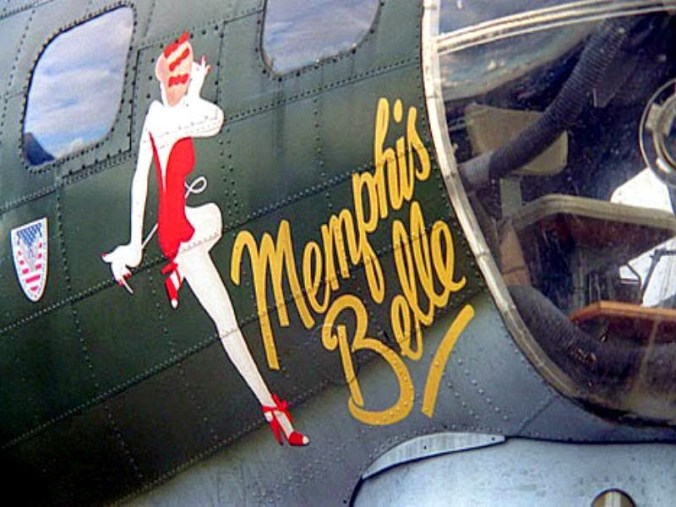
Some named their aircraft after their mothers or a cartoon character or movie quote. But that seems to be the exception rather than the rule. Others named their plane after a wife or girlfriend (as in the case of the Memphis Belle). More still came up with a name that may be lewd or a double entendre. Here are just a few names from the 100th Bomb Group: Pasadena Nena, Angel’s Tit, Jersey Lilly, Sweater Girl, Mismalovin’, Miss Chief, Miss Behavin’, and Liberty Belle. My wife’s grandfather was the waist gunner on a B-17 named Luscious Lucy. It seems that they were split between blondes and redheads as the hair color of choice on their planes. Given the paint schemes on the aircraft, black or brunette would not have show up as well I think.

lusciouslucy

Luscious Lucy over England on a training flight over England, Feb. 1944 351st Squadron, 100th Bomb Group

Growing up, I had a strange fascination with World War Two aircraft. I could give you all sorts of details, armaments, turning radius, rate of climb, etc that was unusual for a child my age. What makes it even stranger is that I have a deep fear of flying. It was a strange juxtaposition that I cannot explain. I was lucky enough to know some of the men who flew these planes. My grandparents had a friend that we went to church with (his wife taught my Sunday School class) who was a co-pilot on a B-17. He was shot down and spent a year in a German POW camp. I’ve met a few others along the way too. Brave men, all. I wish I had known my wife’s grandfather as I am sure that he had stories to tell, though, like many of his generation, he was tight lipped about it. He flew seven missions as a waist gunner, including the first daylight raid over Berlin. On one mission, one of his fellow crewmembers was struck in the chest and eviscerated by a 20mm cannon round fired by a German fighter. His blood froze on the clothing of his crew.Her grandfather flew and fought at his position for several hours with frozen entrails clinging to his flight clothes.

memphisbellenoseart

Now I know that by our standards today, such images as those that decorated the planes of World War Two are seen as sexist, degrading, and/or objectifying of women. But I humbly state that they lived in a different era. They were young, and many died terrible deaths. If such images brought them comfort, well, who can really blame them? We should not judge unless we too flew those brutal missions over Germany. Only those who have been there can fully understand. I will now leave you with a quote from a poem by Randall Jarrell entitled Losses. It is, in my opinion, some of the best words written in the English language about warfare:

In our bombers named for girls we burned

The cities we had read about in school  

Hutch

100_1280

My sexy pinup girl.


The “Good” Old Days Weren’t

good-old-days

Dear Readers,

There is a false impression of the past shared by many who long for the “good old days”. In the eyes of some, in the past people did nothing but go to church, pray, and do good deeds every day. It’s bulls!t, of course, but the mythic view of the American past survives and is still alive and well today. The truth is, however, that from child prostitution to murder most foul, the 19th Century had it all. The same issues we face now were, for the most part, around back then too. There truly is nothing new under the sun.

In the 1860s, an Englishman visited New York City after the end of the Civil War. He left a wonderful account called Sunshine and Shadow in New York. Though naturally you have to take some of his words with a dose of salt, much of it rings true. Smith, the author, reported that the NYPD in 1866 listed 615 Houses of Prostitution, 99 Houses of Assignation, 75 Concert Saloons of vile repute, 2,690 Prostitutes, 629 waiter girls, and 127 vile bar maids. He goes on to say that waiter girls “are not of the highest moral order”. Now I’m not entirely sure what the difference between a house of prostitution and a house of assignation is, but I assume there must have been one as they were listed separately. Smith also observed “cheap hotels are used for the purposes of infamy.” In other words, they had no tell motels back then too! 30 years earlier, another visitor when speaking of the Five Points said “Every house was a brothel, and every brothel a hell.”

Inside these establishments, women engaged in the oldest profession. Some by choice, but more often by necessity. Girls coming from the countryside to look for work in the city often found themselves drugged and shanghied into a life of prostitution. I also use the word “women” but in reality, many of them were either barely into adulthood or not adults at all. Rumors persisted in the 1860s that Bridget McCarthy who owned a brothel on the corner of Mott and Bayard specialized in providing young virgins for men from the upper classes. When I say young, I mean in the 11-13 age range. Technically it was sort of frowned on, but perfectly legal.

And it wasn’t just New York City. Descriptions of other large cities from the era, including London, are similar to what Smith described in his book. Did you have such goings on in rural areas too? Not to this extent, of course, but yes, violence, child sex abuse, and murder existed in small towns as well. And speaking of murder, everyone has at least heard of Jack the Ripper. But did you know that three years before his reign of terror in London’s East End, another killer stalked the streets of Austin, Texas? Austin was not a big city at all in 1884-5, though it was the state capital. This killer became known as The Servant Girl Annihilator which, in my opinion, is the greatest serial killer name of all time.

Most of your big city newspapers from the period are available on microfilm. If there is a university near you, they probably have enough of them that you can get a good look at life from 1865-1900. Just as now, they talk about crime, corruption, scandal, etc. Spend time reading them and you’ll find that life back then was not all that different than today. In other words, there is no such thing as “the good old days”. Especially if you were a minority.

Murder in Ekaterinburg

90ea400201166d14affb09476e8c4744

Dear Readers,

My interest in Russian History really began with the announcement of the discovery of the remains of the Romanov Family (and four attendants), minus two of the children whose remains were discovered years later. Prior to that, it being the Cold War and all, I remember being taught in school that the Russians wanted to invade the United States, send our parents to Siberia, and force us to be communists. I maintained a healthy interest over the years and read as widely as I could, even going so far as to learn the Russian language, which, I might add, is extremely difficult.

5602efcdc36188686c8b4589

Unlike some who study the Romanov dynasty and its downfall, I am not a monarchist. I emphatically reject the notion that any person is superior to me based simply on their status at birth. I cannot, for the life of me, fathom the Royal Family worship exhibited by many Americans, but I digress. Nor do I look on Nicholas II as a benevolent, kindly man. Sure, he was a devoted father and husband and by all accounts, a great one. Too many people, however, gloss over or ignore his anti-Semitism, his use of a secret police force to target dissidents, and the fact that he was an autocratic ruler who answered to no one. I do not feel sorry for him, nor do I really feel any sympathy for his wife, though she never really got a fair chance from the first time she set foot in Russia. My sympathies do lie with the children, who did not deserve to die because of who their father was. No matter the sins of the Tsar, they should not have been placed upon the children as well. (In the interest of full disclosure, and as I previously noted here, I have a history crush on Maria Nikolaevna, the third of the four daughters.)

maria_nikolaevna_1914

My history crush. (Well, one of them anyway.)

Obscene and vile are the only words that come to mind if I am asked to describe what happened in the Ipatiev Basement in the early morning hours of 17 July 1918. Movies made about the final days of the Romanov Family often depict the murder as being a relatively simple affair. Nothing could be further from the truth. Perhaps it is best that the big screen doesn’t depict what really happened to spare the viewer from the horrific spectacle, but that also does a disservice to history. We like our history neat and tidy, and though we acknowledge that terrible things happen, we don’t necessarily want to know all of the gory details. If that is how you like your history, then do not read any further. But if the truth interests you, then proceed.

yakov_mikhailovich_yurovsky_1918

Yakov Yurovsky

I will give you one caveat. None of the accounts match exactly as to what happened or what didn’t happen. I’m going off of the most probably course of events when all sources are pooled together to create a likely timeline. At the end, I’ll give you the sources I’ve utilized. We’ll never know the exact truth, and I am not saying that what follows is exactly what happened, merely what is likely to have happened. Allow me to repeat: I’m not saying this is the precise order of events with historical certainty, only historical probability. Okay, we’ve gotten the historical caveat out of the way, let us now proceed to basement of the Ipatiev House. The size of the room is somewhere around 23X21 feet, so rather small, though exactly how large or small again varies from account to account.

A single light bulb casts shadows along the walls. Alexei, 13, is seated in a small wooded chair with a pillow behind him. His mother Alexandra, the Tsarina, is likewise seated in a second chair. There were no chairs in the basement when they arrived just a few minutes ago, but Alexei was suffering from a crippling bout of hemophilia and could not walk (his father carried him down the stairs) and Alexandra has been dealing with sciatica for many years and was often confined to a wheelchair. The daughters, Olga (22), Tatiana (21), Maria (19), and Anastasia (17) are gathered behind their mother. Nicholas, former Tsar, stands in between and slightly ahead of the chairs where his wife and son are seated. The family physician, Dr. Botkin, stands behind Alexei. Two others, the cook and the valet, Trupp and Kharitonov, stand along the black wall as does Anna Demidova, Alexandra’s maid, who clutches a pillow with jewels sewed inside. In fact, the daughters too have jewels sewed into their corsets and even Alexei wears an undershirt likewise armored.

The room is cramped and dark. Did they believe they would die? Earlier, Yurovsky who was to be their chief executioner, told them they had to wait for a truck to arrive to take them to a safer place as White forces were getting close to the town. He may or may not have told them they had to take a picture before they left. (Accounts differ on this point.) Finally, the sound of a truck entering the courtyard penetrates the walls of the basement. Surely this means they are about to leave. They family faces the door expectantly and finally it opens. Yurovsky walks in holding a sheet of paper in his left hand. His right is shoved into his pocket. But behind him? Ten other men enter clutching pistols. They look young and even scared. Several of them sport bloodshot eyes and stagger a bit from the alcohol they’ve spent the past several hours drinking. Earlier that night, two young men refused to take part in the execution and said they could not shoot the daughters. Yurovsky excused them from the duty and replaced them with two others. Six, including Yurovsky, are Russian. The other five are Latvians. Each has been assigned a specific person to shoot and told to aim straight for the heart to kill quickly and avoid excess bleeding that they’d have to clean up later. They close the door behind them. At this point, I think the Romanovs and their servants must have known, or guessed, what was about to happen.

Yurovsky orders everyone to stand. Alexandra rises from her chair but Alexei cannot. He begins to read the order sentencing them to death. As soon as he finishes, Nicholas looks at him in shock and asks “What? What?” Yurovsky reads the order again. Alexandra begins to cross herself. Yurovsky yanks a pistol out of his pocket and fires a round straight into Nicholas’ chest. The others open fire but rather than shoot at their assigned victims, they too riddle the Tsar’s body with bullets as he slumps onto the floor. Everyone wanted to be able to claim they killed the Tsar, but gunning down the Tsarina or her beautiful daughters? There is no honor in that. The men begin to fire wildly as the women scream in terror. The men in the back are firing over the shoulders of the men in front of them, so close that some suffer permanent hearing loss while others are burned by the muzzle flashes.

The air quickly becomes dense with smoke. Bullets ricochet off the plaster walls and rattle around the room. Some of the bullets intended for the Nicholas instead strike Trupp and Botkin, who goes down with wounds to the abdomen and shattered kneecaps, none fatal. Trupp dies quickly from a wound to the head, as does Kharitonov. Alexandra turns her head away and tries to cross herself as Ermakov, one of the executioners, raises his pistol from very close range and pulls the trigger. The bullet strikes her in the head. Blood and brain matter spray into the air. Through it all, Alexei still sits in the chair, unhurt, as his father’s blood slowly runs down his face.

There is a door in the back of the basement. Perhaps it offers a chance of escape? Maria desperately tries to claw the door open until a bullet to the thigh crumples her to the floor. A leg wound likewise drops Anna Demidova to the floor where she passes out from shock, fear, and pain. Olga, Anastasia, and Tatiana cower in a corner. The air is so thick with the choking fumes from the pistols that the executioners can’t see or breathe. Yurovsky orders them to stop. He opens the doors and the men step outside into the cool night air. Some vomit. But there is still a job to be done. What should have been quick was anything but. A few men grab rifles with bayonets from another room and return to the basement.

The floor is slick with blood. The room stinks of gunpowder, blood, urine, and feces from bowels loosened in death or fear. Alexei still sits in the chair in a terrified state of paralysis. Yurovksy empties his Mauser revolver into Alexei’s chest with seemingly little effect. Finally he slumps to the floor where he lies moaning, still alive. Attempts to stab him with a bayonet prove useless as it cannot penetrate his “armor”. Finally, Alexei is dispatched with two rounds through his ear and into his brain. In the far corner, Olga and Tatiana are shielding Anastasia with their own bodies. The men approach, feet slipping on the bodily fluids pooled on the floor.

The older to girls try to stand up. Tatiana makes it to her feet and is cut down by a bullet through her head which exits her face and covers her sisters with blood as they shriek hysterically in terror. Olga is shoved back onto the floor and shot in the head. Botkin is likewise shot through the head as he lays wounded on the ground. Anastasia crawls over to where her sister Maria lies wounded. She is dragged away and, like her sister, is finished off with numerous bayonet thrusts, blows from rifle butts, and a bullet to the head. What should have taken seconds has taken twenty terrifying minutes.

Suddenly, Anna Demidova regains consciousness! She sits up and exclaims “God has saved me!” The men turn on her with bayonets. Anna fends them off by using her jeweled pillow as a shield. Finally, the shield is knocked away. As Ermakov lunges with a bayonet aimed for her stomach, she grabs it with her hands. Blood runs from her hands as it is forced into her stomach. She is finished off with numerous bayonet thrusts and rifle butts. Later, as the bodies are loaded into the back of the truck, one of the daughters, either Maria or Anastasia suddenly sits up and screams. She is dragged from the truck and finished off with bayonets and rifle butts. Finally, finally, it is all over.

%d1%80%d0%be%d0%bc%d0%b0%d0%bd%d0%be%d0%b2%d1%8b

One of the last group photos of the daughters, taken while in captivity.

I will not go into detail about the burial of the remains other than to say they were first placed in one location, then removed the next day to a different site. There, an attempt was made to burn the two smallest bodies (Maria/Anastasia and Alexei). Those two bodies were buried in a separate grave than the rest. Thus, when the official exhumation of the remains took place, two bodies were missing. This poured fuel on the fire of those who desperately hoped Anastasia survived. Scientists all agree Alexei was missing, but some stated the missing body belonged to Maria and others to Anastasia. It wasn’t until 2007 that the second grave was discovered.  Though it isn’t know for sure if Anastasia or Maria was in the grave with Alexei, DNA has proven that ALL the members of the family died in the basement. There were no survivors, which isn’t surprising given the brutality of what took place. Despite the DNA though, there are still people out there who hold desperately onto the belief that Anastasia survived. I’m not sure why, really. But it is what it is.

As I stated at the beginning, I have no sympathy for Nicholas or Alexandra. My sympathies lie with the children, especially Maria whom I’ve had a history crush on for a long, long time. Perhaps when I die, my spirit will float back through time and I will have the chance to dance just one waltz with her in Saint Petersburg.

Hutch

The Fate of the Romanovs King & Wilson

The Last Days of the Romanovs: Rappaport

Nicholas and Alexandra: Massie

The Romanovs: The Final Chapter: Massie

Also, the best online resource out there: The Alexander Palace here.

Murder, Utility Knickers, and the Seamy Side of Wartime England

policeman-ww2

Friends,

Arson investigators have a difficult job since the crime in their case, fire, can do a number on your crime scene! (as can the firefighters sometimes) That said, it leaves evidence behind also. You just have to know where to look for it. Fires leave patterns, accelerants leave traces, and people leave clues. This makes a tough task a little easier. Imagine returning to the scene of a murder only to find out that it has been bombed into oblivion. That, Dear Readers, was the task faced by the intrepid Inspectors from Scotland Yard during the Second World War.

Though often we look at times of national catastrophe or struggle as a uniting factor that brings people together, that does not negate the fact that under it all a criminal element still lurks in the shadows. In the case of the blacked out cities of Europe, those shadows grew larger and the hiding places more numerous. Even Berlin, the city at the center of Hitler’s Empire was rocked by a series of bizarre sex murders in 1940 though the government kept it secret as the Kriminalpolizei (Kripo) quietly worked the case. In fact, as we will see, secrecy was a big issue in dealing with crimes in wartime.

Sir Robert Peel created the Metropolitan Police in London in 1829 while serving as Home Secretary. This paved the way for the first large professional police force in the world. And, maybe more important, it led to police officers being called “Bobbies” or “Peelers”. In fact, the Irish (my people!) brought the term “Peeler” with them to the United States and it was the first commonly used slang for police officers in eastern cities in the US. Can’t say it is all that popular anymore. I never got called that during my time in law enforcement. But it would have been cool if I had. By the time England declared war on Germany in September 1939, the British police force and the government intelligence branches (MI 5 and 6) were up to the challenge. Just as they had with the Fire Service, the government hired thousands of auxiliary policemen to help fill the spots left open by those who left to enlist in the military. However, the detective inspectors tended to be long term men who knew their way around a crime scene.

newscotyard

When I was a “peeler”, I worked weekends, holidays, and night because crime doesn’t take a vacation or sleep. Nor does it disappear just because your country is at war. As soon as war was declared, the British police force helped the government in rounding up enemy aliens and people with suspicious loyalties for internment. Some of those interned were British citizens, but that did not stop them, just as it did not stop us from interning Americans citizens with Japanese ancestry.  One question that we must consider is why did crime rates in England go up during the war years? I suppose there are a variety of factors. First, large numbers of people are thrown together in stressful circumstances. That is a major part of it. Second, we have the fact that for soldiers and civilians alike in England, death could come on any given night. This can give rise to a certain sense of fatalism and an anything goes attitude. And then you add in the increased opportunity for crime with blackouts and the like. Thus wartime England was not as safe as you might think.

To begin with, the fact that London remained blacked out for much of the war and people spent a lot of time in bomb shelters meant that your everyday burglars had a field day. Rings of mostly youth with a few professionals thrown in, would watch houses after dark. When the air raid sirens went off, they would see if the people left to go to a public shelter. If so, they could break into the house with little fear of detection. As an added plus, if the house was hit by a bomb or incendiary, then it would obliterate the evidence! Perfect! The British government took a dim view of this as they also did looting bombed out homes but with their resources already stretched thin, combating it proved to be a very tough task. Fraud and the black market also consumed resources, but more important than that was the “serious” crimes of rape and yes, even murder.

flat550x550075f

Time and space dictate that I can only share a few cases with you. First, we have the Dobkin Case. Apparently Mr. Dobkin got tired of his wife Rachel and decided to kill her. Plenty of murders have their origins here it seems. Anyway, he murdered her and buried her body under the rubble of a bombed out church hoping that if she was discovered, the authorities would write it off as a bombing victim. Almost, Mr. Dobkin. Almost! It took over a year for anyone to discover the body and owing to the fact that she had obviously been dead a while, an autopsy was conducted. During said autopsy, the intrepid pathologist Dr. Simpson discovered that the hyroid bone was fractured, thus indicating Rachel died of strangulation. Oops! And as an added oops, Mr. Dobkin covered her body in lime hoping to speed the decomposition but he used the wrong type! (Builder’s lime rather than quicklime) That may have actually preserved the body better than it would have otherwise been! The jury convicted him in less than a half hour and he was promptly hanged. Makes you wonder if other people tried this very thing and got away with it, doesn’t it?

Though often called a serial killer, our next dealer of death is really more of a spree killer. In serial murders, the killer has a “cooling off” period in between according to the almighty F.B.I. Young Gordon Cummins did not. He went on a six day murder spree earning him the very English name, “The Blackout Ripper”. On February 10, 1942, the body of a 40 year old woman was found in an air raid shelter. She had been strangled and her handbag was stolen. Inspectors and the pathologist surmised that the killer may have been left handed. The next day, a prostitute was found murdered in her apartment. The victim had been strangled, had her throat cut, and had her sexual organs mutilated with a can opener which was left at the scene. The scene was eerily reminiscent of Scotland Yard’s most famous open case, Jack the Ripper, as it looked like one of his crime scenes. Luckily, they were able to get prints off the can opener. The Home Office clamped down on the story as they did not want to spark a panic. However, worse was to come. And quickly.

gordon-cummingsf

Gordon Cummins

The next day, yet another prostitute was discovered murdered in her apartment. The scene was one of the most brutal you could encounter back then. She had been strangled with a stocking. The killer took the time to mutilate her with several objects and to violate her body with a candlestick. The next day, he struck again. This time the victim was not a prostitute but a 32 year old married woman. She too was strangled and mutilated. Word reached the press despite the wishes of the Home Office and they dubbed the killer the “Blackout Ripper”. Unlike Jack, this guy wouldn’t quit. He took a day off after his fourth murder and on Valentine’s Day, he struck again. This time his dastardly deeds were interrupted by the arrival of a delivery boy and his victim survived. She reported he was wearing an RAF uniform and when he made his getaway, he left his gas mask and its case behind! Hours later a prostitute reported she had been approached and then attacked by a man in an RAF uniform too. She fought him off and he left his belt behind during his escape.

His gas mask had a serial number and inspectors tracked it to a Gordon Cummins. Upon searching his apartment, they found items belonging to the victims and matched his prints to the one on the can opener. Naturally, he was promptly convicted and even more promptly hanged, during the middle of an air raid, no less! He may have killed other women and there were some within Scotland Yard who believed he did.

evelyn-oatley-2

Evelyn Oatley, the beautiful second victim.

As much as we would think that hard times bring a country together, as you can see, the worst elements of our society are still very much present for duty also. When the Americans arrived in England, our cousins across the pond liked to blame the presence of our soldiers for the increase in crime. They said at the time that the problem with the Americans was that they were “overpaid, oversexed, and over here!” I doubt that had all that much to do with the increased crime rates though it not doubt added to the rate of unwed pregnancies, after all, some of the English women wore utility knickers. One Yank and they were off! VD rates soared as did prostitution. I’ve seen estimates that one out of every ten American soldiers in Europe during the war contracted some sort of “unwanted guest” but I do not know how accurate those statistics are.

american-soldier-recreating-first-date-with-scottish-girl-who-will-become-his-bride

Hey lady, on a scale of zero to America, how free are you tonight?

As tempting as it is to complain about working conditions, and Lord knows I did enough of that when I was a peeler, at least you don’t have to work whilst bombs fall around you. Air raids tend to make a right cock up of crime scenes. Thankfully, we don’t have to worry about bombs. Rookie patrol officers on the other hand……

My name is Hutch and I am a Half A$$ Historian who never met an English girl wearing utility knickers, unfortunately.

P.S.: For more along these lines, check out Murder on the Home Front by Molly LeFebure and the PBS film by the same name.

Murders in Paradise

Postwar Los Angeles, where prostitutes and pimps, perverts and panty sniffers mingled with detectives and derelicts, cowboys and conmen. As the city’s population exploded with a postwar housing boom, organized crime exploded as well. Bugsy Siegel set up the Flamingo Hotel where his buddy Mickey Cohen ran a gambling racket. In 1947, the mob had Siegel bumped off after they grew suspicious that Siegel and his insanely attractive, if a little off in head, girlfriend Virginia Hill were skimming money. Someone popped Siegel with an M-1 Carbine through the window. Was it really money? Or did his own girlfriend set him up? We’ll never know. Virginia was found dead in a park in Austria in 1966, an apparent suicide. After Siegel’s death, Cohen grew more influential along with his top lieutenant, bag man, and enforcer Johnny Stompanato. Handsome Johnny went on to date the gorgeous Lana Turner until her thirteen year old daughter stuck a knife in him. A kid punched the ticket of the most dangerous man in town. Officials ruled the death a case of self defense.

d699d14629a5c93f0cd095ed38d144a3

Virginia Hill…..femme fatale. In my mind, I picture her as a redhead. Femme fatales always have red hair.

Gangsters imported reefer and H while Hollywood stars basked in the Golden Age of American films. High ranking officials within the city and the police department were on the take as well. LAPD ran a Red Squad to track known and suspected communists as well as protection rackets. High ranking police commanders looked the other way while gangsters slung dope, preferring to target black teenagers and pachucos for drug offenses without targeting the supply side. Who were the good guys? Who were the bad guys? Who knows! Everybody was out to make a quick buck. And there were plenty of opportunities for that in the City of Angels.

There were plenty of opportunities for murder as well. The defense industry in Southern California boomed during the war years and with the end of a shooting war and the beginning of a cold war, it showed no signs of letting up. During the war, single women made their way to the city to work, renting rooms in flophouses, hotels, or private residences. The men came home after 1945 and brought domestic homicide with them. Couples fueled by alcohol battled with fists. Sometimes, the wife ended up dead. Women offed their husbands too, though not as often.. And let’s not forget the murder suicides. The police had little difficulty solving domestic homicides and sent plenty of men to the gas chamber at San Quentin. But was there something else stalking the city? Some diabolical fiend out to torture, murder, and mutilate women? Well, Dear Reader, read on if you dare and then you can tell me.

ora_oraportrait

Ora Murray

On the night of July 26, 1943, Ora Murray, 42, went out dancing with her sister at the Zenda Ballroom. She hooked up with a dapper man who called himself Paul. He offered to drive her around a show her the sights in Hollywood. Orra agreed. Several hours later, a dog owned by a caretaker discovered the partially nude and badly beaten body of a woman on a golf course. It belonged to Ora. Her undergarments had been violently ripped away and the killer removed her dress and then wrapped it around her body. He also placed a white gardenia on her shoulder. Odd, that. Strangulation was the official cause of death. Now this murder took place just outside the city limits and so the Sheriff’s Department handled the investigation, which went nowhere fast. Meanwhile, the bodies continued to stack up.

6ec033b2d566b578f3dd23c92522ef57

Georgette Bauerdorf, a life lost too soon.

She was young, rich, beautiful, and, on Oct. 11, 1944, very, very dead. That night, Georgette finished her shift as a hostess at the Hollywood Canteen where she danced with servicemen. When she drove away in a Pontiac Coupe, it was to her own rendezvous with death. At 11:00 am the next morning, a maid found her body floating in the bathtub with the water still running. She wore the top part of a pajama set, indicating that she returned home unmolested and prepared for bed. Her badly bruised knuckles and scratches on her bare thighs told detectives that she did no go gently into that good night. The police believed she returned home, ate a snack, and was attacked by a person whom she may have known. They further postulated said person might have been lying in wait. A neighbor said they heard her yell “Stop! You’re killing me!” around 2:30 am but they ignored her cries as they assumed it was a simple domestic dispute. (Other than the “You’re killing me part, I guess.)  Though the killer beat Georgette and put her face down in the bathtub, the police found a bandage shoved down her throat which caused her to asphyxiate. The killer drove off in her car which was found abandoned later, gas tank empty. The case went cold and investigators never found her killer.

4623b461f287b8e846e1fec0010fdb52

Elizabeth Short. The Black Dahlia.

black_dahlia_10

The Crime Scene.

She is perhaps the most famous dead girl in American History, a young woman drawn to the glitz and glamour of Hollywood with dreams of becoming an actress. But like so many would be stars, reality soon set in. Her mutilated and bisected corpse was found in a vacant lot on 49th and Norton in Los Angeles on January 15, 1947. Elizabeth Short was only 22 when she died. Journalists dubbed her The Black Dahlia, and her murder has inspired much speculation in the decades which followed. I’m not an expert on her murder, though I’ve read widely about it. There are numerous suspects, though none were ever charged. What the person or persons responsible for her death did almost defies even the most diabolical minds. They kept her alive for a short period of time.  Bound, tortured, forced to eat feces, the official cause of death was determined to be bleeding from multiple deep lacerations to the face coupled with shock from repeated blows to the head. It is the most heinous of crimes, and Elizabeth Short never got the justice she deserved.

french2

Jeanne French.

Not even a month after Elizabeth Short died, another woman, Jeanne French, met her death at the hands of a fiendish killer. She was 45 years old, a nurse, a pilot, and the former wife of a rich Texan in the oil business. A construction worker on the morning of February 10th saw what he thought was a pile of women’s clothes. He walked over to investigate and saw a fur coat. When he lifted it, the man received quite a shock. Underneath the coat was the brutally beaten, nude body of Jeanne French. The killer struck her in the head with a blunt instrument, perhaps a socket wrench, and the proceeded to beat and stomp her to death. The blow to the head didn’t killer her. Internal bleeding from her fractured ribs did. It took her a long time to slowly bleed to death. The coroner believed she was probably unconscious after the blow the head, a small mercy for sure. The killer then removed red lipstick from her purse and wrote “Fuck You, BD” (or maybe PD) on her body. She’d had a fight with her estranged husband the night before her death, but his whereabouts at the time of the murder were attested to. Jeanne was last seen alive at a club in the company of a “swarthy” man. They left together. But this, as the others, went cold. Police rounded up the usual suspects, but came away with nothing.

From the file labeled weird comes the strange case of the murder of 15 year old Lillian Dominguez. On the night of October 2, 1947, young Lillian attended a school dance. When it ended, she set out for home with her sister and a female friend. As they passed the intersection of 17th Street and Michigan Avenue in Santa Monica, the trio crossed paths with a man who walked by them in the darkness. They walked a few feet and Lillian told her sister “That man touched me.” A few steps later she yelled “I can’t see!” and promptly collapsed and died on the pavement. The cause of death? Stabbing. The killer stabbed her straight in the heart with either a stiletto knife or maybe an ice pick. Though she had two companions with her, they were unable to give any description to the police other than the fact that the killer had been male.

0099de481707baf0940251b44f978098

Death prowled these streets.

And there were others. Too many to give full attention to, as they deserve. Evelyn Winters, 42, found nude, beaten and strangled to death in March of 1947. Laura Telestad, 37, found nude and strangled with a strip of cloth. Body dumped in a vacant lot. Rosenda Mondragon, 20, found nude, tortured and strangled. Body dumped a mile from where Evelyn Winters’ body was discovered. Gladys Kern, 50, a real estate agent found dead in a house she was scheduled to show in 1948. Beaten and stomped to death. Louise Springer, kidnapped in her car. Found beaten, strangled, sexually assaulted and sodomized with a tree branch. Jean Spangler, 27, had been a roommate of Elizabeth Short. Jean disappeared and her body was never found.

springer-headline-9-victims-300

Was Los Angeles in the grips of a fiendish serial killer? The short answer is maybe. I’m not an expert in homicide. When I was a detective, arson was my specialty, but I’ve received training in homicide investigations and have worked arson-homicides, so I know a thing or two, but Freud I ain’t. The manner and method of some of these cases would indicate that the police may have had one assailant on some of them. But others don’t really fit given the age or manner of death of the victim. I do think we can say with some certainty that some of these cases were the work of one person. Murders are not new. Crime is not new.

If anything, the study of history teaches us that f—-d up people have been around forever. Serial murder is not a recent phenomenon, nor are sexual homicides. Though we look back with a bit of nostalgia, the truth is Los Angeles was trapped in its own true life noir tale in the 1940s. With the police and city administration on the take, evidence could be made to disappear (as happened with the evidence associated with the Dahlia case). Cases could be penned on a minority to protect a well connected individual. Though the police were able to do more forensically at the time than you might think, it wasn’t enough. Given the time that has passed, these women will never get justice. Their killers got away with it. And that, Dear Readers, is a tragedy.

L.H.

P.S. – For a fun glimpse at post-war Los Angeles, check out my favorite PlayStation game L.A. Noire. It’s available on the PS3 and PS4. Seriously, I play the shit out of it. If I could live inside a video game, it would be either L.A. Noire or Red Dead Redemption 2 (and maybe the first one too).

P.P.S. or P.S.S. – The best serial killer name of all time is the Servant Girl Annihilator who terrorized Austin, Texas in the mid 1880s. Talk about keeping Austin weird…

London’s Burning: A Night With the London Fire Brigade During The Blitz

article-1342305-0c6d3218000005dc-785_634x401

I few days ago I discussed the civil defense system in Germany during World War 2, so I thought it appropriate to revisit my ode to the London Fire Brigade during The Blitz. First published on my old site.

Friends,

Just like the warning labels on firefighter’s bunker gear and helmets say, firefighting is an inherently dangerous occupation. An average of 77 firefighters died in the line of duty each year since 2010. This is down from an average of 151 per year in the 1970s. Still, the job puts incredible demands on the men and women who answer the calls. Given the fact that 9/11 and Pearl Harbor aside, the firefighters in the United States have not regularly been called upon to put out fires in the midst of bombing raids. It has happened on two days here, and one of those days, 9/11, saw over 300 of FDNY’s bravest killed in action. This hit home to me because I was a firefighter then. And having started out in life as a firefighter before I went over to the dark side of the force (law enforcement), I feel a certain kinship with the men and women who struggled to save lives and property during the darkest days the world had ever seen.

During the 1930s, architects of air power worldwide demonstrated the vulnerability of cities to aerial bombardment. The German Condor Legion, fighting in the Spanish Civil War, brought this point home to Europe when they pummeled the town of Guernica. Thanks to Pablo Picasso, who from what I understand was a pretty screwed up dude, the world knows of this because of his painting of the same name. As Europe marched closer and closer to war, the British government tried to plan ahead. The London Fire Brigade was an entirely full time department but many of the other parts of England relied on a mixture of full time and on call firefighters, similar to our volunteer firefighters in the United States. In 1937, Parliament authorized the establishment of an Auxiliary Fire Service to be made up of men and women to supplement the ranks of the paid fire crews in the event of a national emergency.  This proved to be a wise decision as two years later, war did come. By the time it ended, over 270,000 men and 70,000 women served in either the National Fire Service or the Auxiliary Fire Service.

aircraft-spotter-london

Let us first consider the difficulties faced by the men and women of Britain’s Fire Service and the people of London, Manchester, Liverpool, etc, when the bombing began. First of all, fire stations are above ground, of course, and that is where all of the fire apparatus (or appliances as they call them across the pond) are stored. This means that they are just as vulnerable as a civilian’s house or an industrial target. Second, hospitals are also above ground. Imagine being injured and taken to a hospital only to be killed by a second bomb while waiting in an emergency room. Sounds terrible and it happened. Putting out fires is tough work, but imagine doing it while bombs are falling all around you. The men and women of the Fire Service did it routinely. They did not seek shelter from the shrapnel of exploding high explosive rounds or the burning goo of an incendiary bomb. Rather they went out into the fire lit night and did their jobs. And they died in scores.

For eight months, one week, and two days the German Luftwaffe rained bombs on the people of London and also other cities in England. It began on a Saturday afternoon, September 7th, around 5pm. Today it is sometimes called Black Saturday. This would start a period of sustained bombings that would see London bombed for 57 consecutive nights at its height. Over 400 civilians died that evening and over a thousand others were wounded. Two firefighters and a female air raid warden were among those killed and over a dozen firefighters injured. If you want to see a minute by minute and bomb by bomb account, check out this link. The London docks were hit causing a massive fire. The reporting Station Office is reported to have said “Send all the pumps you’ve got! The whole bloody world’s on fire!” It is amazing that the London Fire Brigade was able to keep such records in the midst of such an attack. And they say that the Germans are good record keepers!

blitzcat

“Keep calm and carry on” was the slogan of the day. (And you thought all the posters and t-shirts you see today are a new creation!) The British people went about their jobs as best they could during the day, as there was a war on, after all, and spent their nights huddled in private bomb shelters or in the “tubes” of the city’s underground subway system. By the end of October 13,000 civilians were dead. And there were more to come. Perhaps the biggest raid of the war, with the most potential for destruction, took place on the night of December 29th, 1940, a night called the Second Great Fire of London. If the London Fire Brigade and the Auxiliary Fire Service could not rise to the occasion, the city might be lost. Given the fact that I am not a real historian, but rather a Half A$$ Historian, I will now depart from the usual narrative and take a bit of dramatic license. You will now enter a time machine and be inserted into the role of a member of the London Fire Brigade.

You are 36 hours into a 48 hour shift. The wartime demands have caused a different shift schedule. You now work 48 hours on followed by 24 hours off. Then rinse and repeat. Even your off time isn’t really off. After all, it isn’t like the Jerries won’t come over whilst you are on a brief holiday. Bombs still fall on your off period and sometimes you have no choice but to report back to work, snatching what sleep you can in between alarms. Your station, in the East End of London has escaped damage thus far, but manning the station in the midst of an air raid is terrifying. You can hear bombs falling all around you and hear the clang of shrapnel from the anti-aircraft shells bouncing off the roof. Outside a helmet is a must. You risk death otherwise. When the alarm comes in, you jump on the engine, just like in peacetime, and head out the door. But this time your driver has to dodge shell craters and debris. All hope for a quiet night is shattered when the air raid sirens begin to wail around 6pm. A quick check of the equipment, and then it is time to wait for the Central Office to call with an assignment. Women man a control board in the candlelight waiting to receive reports of fires and send you out towards an uncertain fate.

download

Tonight the East End gets a pasting, as does the center of the city. You race from one burning block to another trying desperately to stem the tide of the bombs which just don’t seem to stop. Around 2am, you respond to a report of a direct hit on an air raid shelter. These calls are the worst. Bombs can kill people in many different ways. One of the most unusual is “blast lung” where the victim’s lungs are destroyed by the pressure caused by high explosives. You think of them as the lucky ones. They look as though they are asleep. You want to shake them and tell them to wake up and move along. Normally, high explosives blow people apart. You don’t deal with bodies so much as pieces of bodies. Arms, legs, heads, brains, stomachs, hopes, and dreams, all shattered by an unseen enemy. And then there is the constant smell of roasted flesh which never seems to leave your nose. Even on your off days, you wake up and smell it. There are a few victims trapped. Despite the roar of nearby flames, the drone of German aircraft, and the constant bark of anti-aircraft guns, you press your ear into the rubble hoping to hear a sound. You tap on a piece of pipe and listen again. Someone faintly taps back. A fury of digging ensues and soon you uncover a young woman. Her leg is pinned beneath a heavy beam. You and several of your mates lift in while another pulls her out. Part of her shattered leg remains behind. The ambulance crew frantically searches for a tourniquet but when they manage to produce one, she is already dead. And the screams. Dear God, the screams. The screams of the trapped, the screams of the dying, the screams of those who have survived but lost their entire family. You’ll never get them out of your head. No matter how long you live.

9061_538

The crew fighting a blaze one street over is caught in the open when a bomb explodes. Three of them are killed and five more seriously injured. They are whisked away to hospital where another will die a few hours later. And the fires keep coming. The city is facing a fire storm with fires merging together and creating a tornado of fire that threatens to destroy the center of the city. As you spray water on a burning building, a wall collapses nearby, adding another firefighter to the list of the fourteen who will die tonight. Another 250 will be injured, some severely. But you and your mates hold on. Against all odds, you manage to gain the upper hand. As the sun rises, partially obscured by the smoke which still wafts over the city, the dome of St. Paul’s Cathedral is still standing. Despite Jerry’s best efforts, it is still there as a symbol of the city’s determination in the face of everything that can be thrown at it.

firemen-using-hoses-on-the-inferno-at-eastcheap-london-ec-at-the-height-of-the-blitz

That, Dear Readers, is a glimpse into one night faced by the men and women of the London Fire Brigade and Auxiliary Fire Service. And that is just one night, one out of many. During the course of the Blitz, two fire stations would receive direct hits. Two firemen died in the first and six in the second. The deadliest raid during the Blitz took place near its conclusion, on May 10th, 1941, when over 1300 Londoners died in a single night. And again, the members of the Fire Brigade answered the call. By the war’s end, over 1,000 men of the Britain’s Fire Service died in the line of duty, with 1/3rd of them being from London. In addition, 24 women of the Auxiliary Fire Service also gave their lives. 6,000 were seriously injured and many more slightly injured. Their sacrifices are commemorated with the National Fire Memorial near Hyde Park, pictured below. I will close with a quote from a member of the LFB who penned these words.

And many learned the nastier ways of dying

Or limped back maimed and shattered from the strife

While all endured unpleasantness and danger

Continually—and learned to love life

And in an era here in the United States, when paid and volunteer firefighters get into heated internet exchanges about what makes a “real” firefighter, allow me to share this anecdote. The paid firefighters were issued one type of boots and the auxiliary another. One Station Officer during the Blitz walked past the tarp covered bodies of 14 firefighters. All he could see of them was the boots sticking out. 6 wore the boots of the London Fire Brigade. 8 wore the boots of the Auxiliary Fire Service. “Well,” he said “they are all equal now.”

firefighters-memorial

May we never forget those who fought to save lives during the worst war the world has ever seen.

Hutch